1. The Comic Came Before the Movie
April 12, 1977: Marvel’s original Star Wars #1 went on sale, according to Lucasfilm Publishing creative director Michael Siglain. May 25, 1977: the film opened, the date CGC uses in its chronology of the comic and movie. July 1977: the cover date of issue #1, which CGC distinguishes from the April release. Those dates put the opening chapter of the comic adaptation in readers’ hands before the film opened. They do not mean there was an April edition followed by a July edition. April tells you when the issue debuted; July tells you how the issue is dated on its cover.
In an inventory, give the two dates different fields. For the original issue, enter “April 12, 1977” under issue release date and “July 1977” under cover date. Keep the film opening in a historical note, if it matters to the collection, rather than in either publication field. If the object is a later reproduction, the April date still belongs to the history of the original issue, not the production history of the object in hand. A listing that says “July 1977” has not necessarily gotten the release date wrong; it may be transcribing the cover. A listing that says “April 1977,” on the other hand, has not supplied evidence that the particular copy was printed or sold that April.
Lucasfilm’s editorial history credits Roy Thomas as writer and Howard Chaykin as artist on the original series and describes Marvel serializing the film adaptation before the movie’s May release. The film story runs from the opening chapter in issue #1 through the conclusion in issue #6. That boundary matters for a reader: issue #1 is the start of the adaptation, not a one-issue version of the film. It also matters for a cataloger. Record the item as issue #1 and its contents as the first chapter of a six-issue adaptation. That describes what the book contains without implying that the other five installments are part of the item.
The account of the adaptation establishes a sequence, not a manufacturing or shipping history. Knowing that Marvel started the serial before the film opened does not date every installment to the weeks before May 25. Nor does the documented April debut establish when a particular copy reached a particular shop. Those distinctions matter if a seller describes a loose copy as having been bought before the movie. The timeline makes that account possible for the original issue, but it does not verify the purchase. If a copy comes with such a story, record it as reported provenance, separately from the documented release date. The dates are useful precisely because they answer a narrower question than the history of any one copy.
Consider a hypothetical reader who wants to see how Thomas and Chaykin tell the film’s story in installments. A later reprint of #1 could meet the immediate goal of reading the opening chapter, provided the copy is readable and the buyer knows what it contains. If the reader wants the entire adaptation, the relevant question is whether the purchase provides the story through #6, not whether the first chapter is on 1977 paper. A faithful presentation of one issue still leaves five chapters to find. A listing that calls an item “the original Marvel adaptation” may be describing the work reproduced inside rather than the age or printing of the item offered.
Now consider a hypothetical collector who wants the physical issue associated with the pre-film debut. For that buyer, the same first chapter and familiar cover are not enough. The deciding evidence concerns the edition of the copy being offered. A reproduction can preserve the issue number, artwork and original date as part of what it reproduces. Conversely, the July date on an original is no objection to its April release. That collector should ask for evidence of the printing rather than look for an April date somewhere on the cover. If the offer consists of a title and an image that might be a stock photograph, the chronology identifies the historical issue but leaves the offered object unverified.
The two buyers could therefore describe the same hypothetical offer differently without disagreeing about any date. The reader might record “opening chapter present; later printing acceptable” and look for the remaining installments. The first-print collector might record “original issue debuted April 12, 1977; printing of offered copy not established” and ask for photographs before deciding. A reader who also wants the original artifact may choose to acquire the two separately so that reading the story does not depend on handling the collectible. The distinction starts with the inventory: one entry describes the work and where it sits in the serial; the other identifies, as far as the evidence allows, the physical copy carrying it.
2. Build a Baseline From the Standard 30¢ Copy
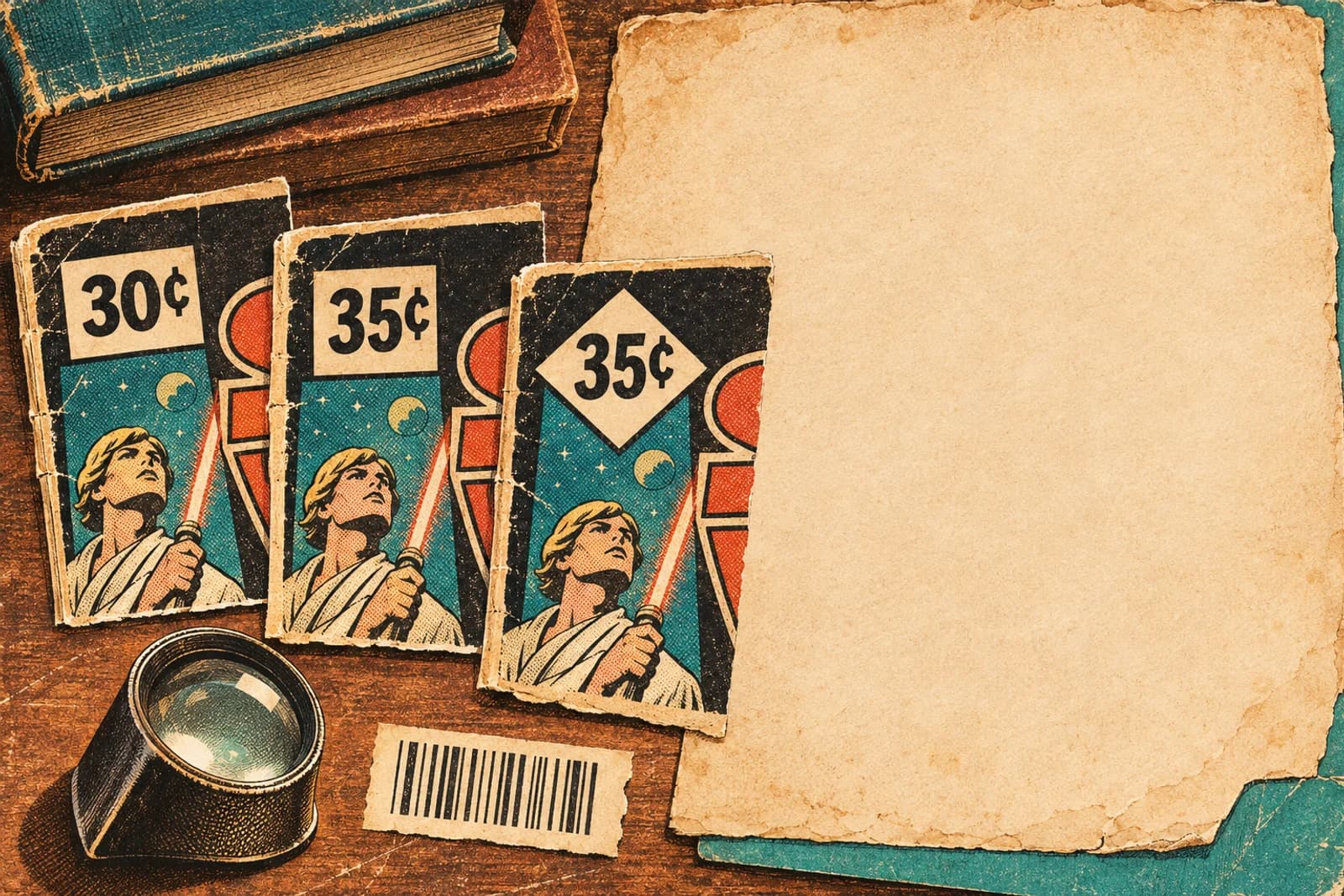
Start with the photographed standard 30¢ copy, not with a seller’s use of “original.” The example is shown in a CGC holder in a sold listing. Its value here is that the front-cover photograph lets you locate details on one actual copy; neither the holder grade nor the fact that it sold is needed for the comparison. CGC’s identification reference supplies the broader context: the standard original 30¢ issue uses a square price box. Treat the photograph as a visual baseline for that layout, not a template that authenticates every apparently matching book. To make the comparison repeatable, keep two columns in your notes, one for what the image shows and one for what that observation supports.
Issue and month panel. Visible: the upper-left panel identifies issue #1 and shows July. Inference: the panel agrees with the issue number and cover month of the standard example. It does not establish when the photographed copy was manufactured or when anyone bought it. Transcribe the issue and month together rather than writing merely “dated 1977.” If a seller’s close-up shows the printed price but cuts off the issue panel, record the latter as unobserved. A clear view of one part of the corner is not evidence about the part outside the frame.
Price area. Visible: the standard example has 30¢ in a square box. Inference: both the amount and the shape agree with CGC’s description of the regular original cover. Record them separately, because “30¢” answers a different question from “square.” A text listing may supply the amount without showing the outline, while a partial photograph may show the outline without making the digits legible. Neither observation by itself establishes a first printing. The photographed 30¢ newsstand reprint also has a square price box, so even a photograph that shows both features sharply does not settle the comparison.
Corner illustration. Visible: there is no visible reprint lettering beside the upper-left character illustration on the standard example. Inference: the photographed area does not show the mark that distinguishes the comparison reprint, which has vertical REPRINT lettering alongside the illustration. Record the location, not just “no reprint mark.” That wording reminds the next person checking the record exactly where to look. It also keeps the conclusion tied to the photograph: a legible image of the illustration and its adjacent margin provides evidence that a blurry image or a crop through the margin cannot supply.
Lower-left barcode. Visible: the standard example has a barcode in the lower-left corner of the front cover. Inference: the barcode is consistent with the reference layout, but it cannot serve as a first-print test. The photographed 30¢ reprint also has a barcode in that position, as well as the same July panel and square price area. The useful comparison is the combination of details, not a vote in which three similarities outweigh one visible difference. If the reprint lettering can be read, the shared features do not cancel it out. If the lettering area is not shown, seeing the barcode does not resolve the missing observation.
Suppose a hypothetical listing shows the center of the cover and part of a square 30¢ box, but the image clips the upper-left illustration and ends above the lower-left corner. Ask for a full, straight-on front-cover photograph plus two close-ups: one of the entire upper-left corner, including the issue and July panel, the whole price-box outline, and the illustration with the strip immediately beside it; and one of the entire lower-left corner, including the area where the barcode would appear. Ask for photographs of the offered copy rather than a cleaner image from a catalog. The full cover puts the details in context, while the close-ups make small print and box boundaries readable. If only the barcode photograph arrives, the corner illustration remains unverified. Do not call the book a first printing on that evidence.
There is a second limit even when the requested pictures all arrive. A cover that matches the baseline gives you evidence about the cover layout; it does not tell you whether another copy retains its interior material. The standard example’s front photograph cannot reveal a missing sheet or a clipped portion of a page in the seller’s book, and a sharp front photograph of the seller’s book cannot answer that question either. Keep “cover consistent with standard 30¢ first printing” separate from a statement about completeness, and do not transfer the photographed example’s grade to another copy. For the hypothetical cropped listing, an honest interim entry would be “30¢ visible; illustration margin and barcode area not shown; printing unresolved; interior not assessed.” That entry identifies exactly what evidence would move the decision forward.
3. What Makes the Square-Box 35¢ Copy Different
The first-print 35¢ Star Wars #1 is a price variant of the original issue, not a later printing identified simply by a higher number on the cover. CGC describes the original 35¢ covers as part of a limited market test. Its cover comparison gives collectors a practical way to begin: the standard 30¢ original and the first-print 35¢ variant both use square price boxes. In that comparison, the amount changes while the box shape stays the same. The higher price matters because it appears in the original square-box layout. A second 35¢ cover appears in CGC’s guide, but its price sits in a diamond and CGC identifies it as a reprint. Recording only “35¢” collapses two different identifications into one.
For a listing, separate the seller’s edition claim from the print you can actually read. If the description says “35¢ price variant” but the photograph shows only the numerals, ask for the full upper-left corner so the boundaries of the price area can be seen in context. A square outline supports the market-test identification in CGC’s comparison. A diamond outline contradicts that specific identification even if the seller got the amount right. If glare obscures part of the outline, it is reasonable to leave the shape unresolved rather than guess from the portion that remains. The useful next step is a better photograph of the offered copy, not a search for another listing that uses the same title.
Heritage Auctions lot 81119 is a documented example of the terminology for the square-box book. The auction house cataloged it as Star Wars #1 35¢ Price Variant and identified it as a CGC 9.4 copy with white pages. That gives a collector an example of an edition description, a numeric grade and a page-quality designation appearing on the same transaction record. Only the edition description answers which version it is. The grade and page designation apply to that particular certified copy and are not features of the variant. Use the lot to see how the edition is named in a documented record, not as a reason to pay more for an unverified book carrying the same wording in an advertisement.
Four fields help keep the claim in proportion. Cover price is the printed 35¢, something you can transcribe. Distribution history is the market-test explanation CGC reports, something you attribute. Original quantity is the number of copies produced, which would require evidence about production. Surviving quantity is the number still in existence, a separate question that would remain open even if a production total were known. The first two fields do not answer the other two. A limited distribution test establishes a reason for a distinct cover price; it does not supply a unit count, a complete account of where the books went or a purchase history for an individual copy.
The often-repeated figure of 1,500 copies belongs in an attributed note, not in a verified print-run field. CGC’s illustrated identification article reports the figure but does not substantiate it with Marvel production records. Heritage’s lot also uses tentative print-quantity language attributed to Overstreet. Neither a description of the market test nor the appearance of quantity language in a catalog establishes exactly what was printed. If the estimate is worth retaining for your purposes, write “1,500 reported by CGC; production total not verified from Marvel records.” Do not shorten that to “one of 1,500.” The shorter phrase turns a reported estimate into an asserted fact and makes the individual copy sound as though it has been traced to a documented run.
Nor can later grading records fill the production gap. Certified examples provide evidence that copies identified as the variant have been submitted and graded. They do not account for copies that have never been submitted, and the number graded does not tell you how many survive. Keep the existence of a documented specimen such as lot 81119 separate from population claims. The lot shows that a particular copy was cataloged as the variant with those grading details. It does not establish the original quantity, estimate losses over time or tell you whether a loose copy offered elsewhere is the same edition.
Suppose a hypothetical seller calls a loose book a “35¢ test-market original, one of 1,500,” and provides a clear photograph of the price corner but no other view. If the photo shows the square box, record “35¢, square box visible; consistent with CGC’s first-print variant comparison.” Put the quantity claim in a separate note as unverified, and leave the individual copy’s distribution history unstated. Ask for the rest of the cover before treating that corner as a description of the whole object. If the new photographs instead show that the first image was a stock photo and the offered book has a diamond box, revise the edition assessment on the evidence of the actual copy. The market-test history explains why a genuine square-box 35¢ cover exists; it cannot make a mismatched photograph evidence of one.
4. The 35¢ Diamond Is a Different Book
Put the two 35¢ covers side by side and the price stops being the deciding detail. CGC describes the square-box cover as a first-print variant produced for a market test. Its identification guide also illustrates a 35¢ reprint with the price in a diamond. These are different edition descriptions, not two names for the same variant. If an advertisement leads with “35¢ variant” and its photograph shows a diamond, the amount may be transcribed correctly while the edition claim is wrong. Check the shape on the offered book before using a listing title to decide which copy fills the slot in your collection.
On the reprint CGC illustrates, the diamond is the easiest clue to spot, but the guide identifies two others. In the upper-left corner, inspect the character illustration for the reprint mark. Then look at the lower-left corner of the front cover, where the illustrated reprint has no UPC. These clues call for different kinds of observations. The box shape is an outline you can trace, the reprint mark is wording you can read, and the lack of a UPC is something you can establish only by seeing the relevant area clearly. A seller may supply a photograph good enough for one of those tasks but not for the others.
CGC describes this diamond-box reprint using the collecting name “Whitman.” The name is useful when searching for reference images or recording how an edition has been cataloged. It does not, by itself, establish who physically printed a copy or where a particular loose copy was bought. Suppose a seller describes a book as a Whitman reprint and says it originally came in a pack. The cover may support the reprint identification without documenting the pack claim. If the seller supplies no packaging or other evidence linking it to that copy, preserve the account as reported provenance, not as part of the verified edition description.
Consider a hypothetical listing whose first photograph shows a clear 35¢ diamond and a readable reprint mark. The bottom of the photograph is cut off just below the main artwork. You already have enough information to reject the seller’s claim that the pictured cover is the square-box market-test version. You also have two positive matches to CGC’s illustrated reprint. What you do not have is a view of the UPC area. An entry that says “35¢ diamond; reprint mark legible; lower-left corner cropped” gives the image full credit without assigning it a detail it does not show. Do not enter “no UPC” merely because none appears within the frame.
Ask for a straight-on photograph of the entire front of the offered copy, with the bottom and left edges in view. If a holder, sleeve reflection, or seller’s watermark blocks the lower-left corner, request a second angle or an unobstructed close-up without asking the seller to take the book out of a certified holder. The full view helps establish that the price corner, reprint mark, and lower-left area belong to the same cover. A close-up can resolve faint print, but an isolated image of an empty patch cannot establish where that patch sits. If a seller sends a catalog image instead, use it to study the layout, not to complete the record for the item on offer.
If the new photograph shows the full lower-left area clearly and there is no UPC, the three observations agree with CGC’s illustrated example. If the lower-left corner is physically missing, record that loss instead: missing paper cannot tell you what was originally printed there. If the new view shows a barcode, record the conflict rather than deciding that the diamond makes the barcode irrelevant. Ask whether both photographs show the same book and check what they actually depict. CGC’s comparison documents a particular configuration; it is not a checklist of every vintage reprint layout. An unexplained discrepancy is a reason to narrow your description, not to invent another edition.
How much uncertainty matters depends on what you are trying to acquire. If you want the illustrated diamond-box reprint and both upper-left clues are clear, you might keep the listing under consideration while marking the UPC area unverified. If the goal is the first-print 35¢ market-test cover, the visible diamond is enough to turn down the pictured book for that purpose, even if the seller never sends another image. If the goal is to document a copy with a specific retail history, a complete cover photograph still will not supply it. Those decisions require different evidence: enough to rule out an edition, enough to match a documented cover layout, or enough to corroborate the history of the individual object.
5. The 30¢ Reprint That Still Has a Barcode
Compare the seller photograph of the standard 30¢ copy with the seller photograph of the 30¢ newsstand reprint. Both show 30¢ in a square price area, an issue panel dated July, and a barcode in the lower-left corner. If those four details were all a seller transcribed, the two covers would produce the same description. The distinguishing detail in these photographs sits higher on the cover: the reprint has vertical REPRINT lettering alongside the upper-left character illustration. No such lettering is visible in the corresponding area of the standard example. The photographs document these two covers, not a rule that every 30¢ reprint must have the same layout.
Read the lettering itself before interpreting the title of an advertisement. A seller can put “reprint” in a title without showing the mark, or call a copy a first printing even though the mark is legible in the photo. Your notes should say which claim comes from the seller and which comes from the object. For the photographed newsstand reprint, “vertical REPRINT beside upper-left illustration” records the visible evidence. “Vintage reprint” is the edition conclusion, not a transcription. The barcode belongs in the observation field, but it does not override the lettering. Here it is a feature the reprint and standard copy share, not a test that separates them.
Try reading three hypothetical photographs of an offered 30¢ copy. In the first, a white reflection crosses the strip beside the illustration. You can read the price and see the barcode, but the portion of the cover that might carry the word is washed out. The correct entry is “reprint-mark area obscured by glare,” not “no mark.” Ask for another view with the light or camera moved so the reflection no longer falls across that strip. If the new picture moves the glare but tilts the cover enough to hide the narrow margin, it has changed the obstruction without answering the question.
In the second photograph, the whole corner is evenly lit, but the image is too small to resolve individual letters. Blowing up the same file may make the strip larger on a screen without revealing anything that was not captured. Ask for a closer, in-focus photograph of the illustration and the full margin next to it, preferably alongside a full front view. Record “area shown; lettering not resolvable” until that arrives. A smudge or dark streak in the right place is not enough to transcribe REPRINT. Nor is a sharper image of the price useful if the photographer has focused on the numerals and left the adjacent strip soft.
In the third photograph, the corresponding strip is fully in frame, clear and unobstructed, with no lettering visible. Now you can make a narrower negative observation: “No REPRINT lettering visible beside the illustration in the supplied close-up.” That distinguishes this image from the photographed reprint without establishing that the offered book is an original in every respect. If a scrape or paper loss crosses the spot, note the damage instead of treating the interruption as a clean blank. The question is not whether you can imagine letters in the image. It is whether the photograph shows the surface well enough to support a statement about what is or is not printed there.
“Reprint” also needs a date or edition context. Heritage separately cataloged a vintage Marvel Star Wars #1 Reprint under 1977 and described it as reprinting the 30¢ edition. That record shows why the word alone does not mean a modern facsimile. It does not make the abbreviated auction description a key to identifying every vintage cover, nor does it establish that the auction copy has the precise layout of the seller-photographed newsstand reprint. Use the auction record to support the distinction between a vintage reprint and a modern reproduction. Use photographs of a specific copy to support claims about its visible layout.
Suppose you already own the standard first printing and want the barcode-bearing reprint for a side-by-side display. A clear image of the vertical lettering answers a question that a high-resolution picture of the barcode cannot. If instead you are screening a copy advertised as the standard first printing, a readable REPRINT mark rules out that description for the pictured cover; an unreadable strip leaves the issue open. In either case, keep the edition assessment separate from condition and completeness. The two reference photographs let you compare printed details, but neither lets you assign a grade to another copy or infer what is intact inside it. If the seller cannot improve the image, carry the uncertainty forward rather than treating silence as a match.
6. When the Book Falls Outside the U.S. Comparison
The U.S. price-box comparison answers a question about certain documented covers. It does not classify every copy that carries the artwork for Star Wars #1. In its December 2017 feature, CGC listed a Philippines category separately from its reprint and 35¢ price categories. That is evidence that CGC distinguished those categories in that reference, not a complete international checklist. It does not tell you how every Philippines copy looks, whether a particular loose book belongs there, or what categories CGC uses for every foreign edition. If the publication details point away from the U.S. examples, keep the cover comparison as a description of resemblance rather than using it to assign an edition.
The next evidence to look for is the indicia, the small-print publication statement inside the comic. If the copy can be opened safely, ask for a readable image of the whole statement and enough of the surrounding page to show where it appears. A close crop can make a few words easy to read while cutting off the clause that explains them. Transcribe the text as printed before normalizing it for search or inventory. Preserve spelling and qualifiers and flag illegible portions rather than completing them from a U.S. reference copy. If the statement is partly obscured, keep the original image with your notes so someone can distinguish the readable text from your interpretation.
Give the transcription four separate fields. Under publisher, enter the name the statement identifies as the publisher, not the first company name you recognize. Under place of publication, enter a location only if the statement identifies it in that role; a mailing address, a printer’s location and a publication place are not automatically interchangeable. Under edition wording, copy any explicit notice about an edition or printing. If none is legible, say so rather than supplying “first edition.” Under date, preserve the wording attached to each date. If one is identified as a copyright date, record it that way. Keep any date on the cover in its own field, where it cannot silently become the date of the edition in hand.
Imagine a loose copy offered as the U.S. standard first printing. Its front has a square 30¢ box, a July panel and a lower-left barcode. The seller then provides an interior photograph in which the publication statement expressly identifies a publisher and place of publication in the Philippines. In this hypothetical, the interior gives you a concrete reason not to apply the U.S. identification to the whole object. Record the three cover observations, transcribe the publication statement separately, and describe the copy as having a U.S.-style cover and interior publication information pointing to the Philippines. Do not add an exact printing, a production quantity or a scarcity claim just because CGC’s historical article supplies a country category.
Change one detail in that example: this time, the only visible reference to the Philippines is part of an address, and the photograph ends before the surrounding sentence. The address is still worth transcribing, but it does not establish what role the named party had. Ask for the full statement if the book can be handled safely. Another useful check is whether the seller’s images show the cover and interior of the same copy, especially if the listing uses a stock cover image. CGC’s published process includes checking the submitted description and says it can reject a book whose cover is joined to the wrong interior. A discrepancy in photographs does not prove that happened; it shows why the relationship between the cover and the interior matters.
Do not make access to the indicia a condition of handling a fragile book. The Library of Congress recommends clean hands, a clean surface, and avoiding folding a comic back on itself. If a seller cannot show the statement without forcing an opening or risking a tear, ask whether a previously taken photograph or a certification record is available. A catalog image of another copy can help you recognize wording if it later becomes legible, but it cannot supply missing words for the book offered. In that situation, “indicia not examined; edition unresolved” is an accurate record of the limit, not an assertion about the condition of an unseen page.
For an unresolved copy, leave enough detail for someone else to pick up the identification. Record what the front shows, which image or page supplied the publication text, which fields are illegible or absent from the available evidence, and the distinction you have not been able to make. A useful interim entry might read: “Square 30¢ box and July panel visible. Publication statement partly photographed; publisher and place not established. U.S. edition claim not verified.” If a clearer image later identifies the edition, add the new transcription and the reason for changing the entry. Until then, a familiar cover does not justify a U.S. label, and a printing you cannot document does not justify calling it rare.
7. How to Read the 2025 Facsimile Checklist

The title Star Wars 1977 #1 Facsimile Edition contains two different pieces of catalog information. “1977” identifies the Marvel issue being reproduced. “Facsimile Edition” identifies the product as a reproduction. Neither the year embedded in the title nor a date reproduced in the artwork establishes when the copy in a seller’s hands was made. The 2025 ordering records document a modern new printing and distinguish several covers offered for it. In an inventory, put 1977 in the field for the source issue and put the modern catalog reference in the field for the edition being identified. If the only date you have for the modern item is the date of the catalog, do not turn that into a precise publication date.
Start with the regular cover. Diamond’s Previews catalog lists the regular new-printing facsimile under NOV247040. That identifier points to a specific ordering entry, not to every product a search engine might return for “Star Wars 1977 #1.” The word “regular” distinguishes this listing from alternate covers; it does not mean the 1977 standard first printing. That distinction is especially useful when comparing a retailer’s short receipt with a long listing title. If the receipt preserves NOV247040 but abbreviates the title, the complete code provides a more precise route back to Diamond’s entry than the title fragment does.
Penguin Random House’s January 2025 direct market catalog lists the foil and Jerry Ordway variants separately. The foil listing carries 75960621261300121. The Jerry Ordway listing carries 75960621261300116. Read those strings to the last digit: both start with 759606212613001, but the remainder distinguishes the two entries. A search based on that shared prefix can put you in the vicinity of the right product without telling you which cover was ordered. Record the full number alongside the distributor and cover description. If an image cuts off the final digits, leave the code incomplete rather than reconstructing it from the seller’s title.
Diamond also catalogs the Ordway cover under JAN251018, describing it as a 25-copy incentive. That gives you two distributor references for the Ordway variant, not two different Ordway covers on the strength of two different identifiers. Keep each code in its own distributor field so a later reader knows where to look it up. The incentive designation describes an ordering threshold. It does not mean the publisher printed 25 copies, nor can you multiply or divide by 25 to recover a production total without knowing what orders were placed, how they were fulfilled, and what was produced. The entries supply no count of surviving copies either.
Suppose a hypothetical shop lists “Star Wars 1977 #1 Facsimile Foil” and gives 75960621261300116 in the product details. The title points to foil, but the complete number points to Ordway in the Penguin Random House catalog. Do not resolve that conflict by assuming either field is always authoritative. Ask the shop which cover it will send and request a photograph of the actual item. If it replies with 75960621261300121 but leaves the original image in place, you have a corrected identifier claim, not necessarily proof of what is on the shelf. If it only confirms that the book is a facsimile, the cover choice remains unresolved.
A catalog image is enough when the question is what artwork the distributor showed for the solicited cover, provided the image is attached to the correct entry. It is not enough when the question is what a seller will ship. For an Ordway copy, ask for a full front image of the offered book so you can compare the artwork to the cataloged cover. For a foil copy, ask for a second photograph taken at a different angle if you cannot distinguish the finish in a straight-on view. Reflections can help show a finish, but glare can also conceal wear. A photograph intended to show the foil effect does not replace an evenly lit view for assessing the surface.
Keep the ordering record and the copy evidence separate even after they agree. For example, a hypothetical inventory entry could read: “Modern new-printing facsimile, Jerry Ordway cover. Catalog references: Diamond JAN251018; Penguin Random House 75960621261300116. Front photograph of offered copy matches cataloged artwork. Interior and condition not assessed.” If all you have is an invoice with JAN251018, change the last part to “order identifies Ordway cover; received copy not checked.” That distinction matters when a seller has several covers in stock or has reused a product image. A distributor identifier can establish which item an invoice or solicitation describes, but it cannot show whether the right comic was packed.
8. The Mini Comic and the Card Need Separate Records
Lucasfilm’s 2015 announcement for the Star Wars Micro Comic Collector Packs describes six miniature reprints of Marvel’s film adaptation. The adaptation itself runs through six issues, but the contents of an individual pack were not the entire serial. Lucasfilm described each pack as containing one mini comic, one foil-stamped trading card, 3D glasses, and a cover poster. It also described 36 trading cards with backs that form a puzzle. The six comics and the 36 cards therefore belong in different checklists. Finding the opening chapter in miniature does not put a particular card in hand, and finding one of the cards does not tell you which comic accompanied that specimen.
Start a loose-card record with photographs of both sides. On the front, describe the image or transcribe any title you can actually read, and note where foil stamping is visible if the lighting shows it. On the back, record any printed identifier and describe the visible puzzle fragment. Do not manufacture a card number from an image position or from a seller’s numbering system. If a listing gives a number, distinguish a number printed on the card from a number the seller assigned. An image of the front can help you compare subjects, but it cannot confirm the back design, and a picture of the back alone cannot establish the condition of the foil on the front.
The announcement is a product-level reference, not a card-by-card checklist. It supports a 36-card target and the existence of the back puzzle, but it does not supply the full set of names, numbers, or positions needed to confirm every individual card from a listing. If a seller offers a loose card attributed to the packs and shows only the front, you can preserve that attribution while leaving its precise checklist identity open. A clearly photographed back may give you something to compare with a documented specimen. If you do not have that comparison, a description such as “puzzle fragment visible; exact position unverified” is more useful than a guessed slot.
Pack completeness is a separate question. Imagine a hypothetical seller offering an opened pack with a miniature, a foil-stamped card, glasses, and a cover poster laid out beside the wrapper. The photograph lets you compare those objects with the four component types Lucasfilm announced. It does not establish that the four items all came out of that wrapper. Record “four announced component types shown” if that is what the evidence supports, and distinguish it from any seller account of opening the pack. If the seller shows only a closed wrapper, you can describe the packaging visible in the photo, but you cannot check the identity or condition of the objects inside it from that view.
Assembling the full card set calls for a different check. In a hypothetical lot advertised as “36 cards, complete,” count the physical cards and check for duplicates before marking off 36 distinct entries. In handy groups, photograph the fronts and backs in corresponding order so that a back image can be traced to the exact card it belongs to. If the backs can be arranged into the announced puzzle, document the layout and note any gaps, repeats, or pieces you cannot place. The puzzle is a useful cross-check, not a substitute for matching individual cards when better documentation exists. Thirty-six pieces of cardstock in a lot and 36 identified cards are different findings.
For the loose comic, make the format explicit before recording the issue number. A hypothetical entry might read: “Star Wars #1, opening chapter of the Marvel film adaptation. Object: loose miniature comic, attributed to the Micro Comic Collector Packs announced by Lucasfilm in 2015. Evidence: seller’s front and back photographs show the offered miniature; issue number legible on front; no wrapper pictured. Condition observation: crease visible at the upper corner of the front cover. Interior not examined. Card, glasses, and poster not included in the pictured offer; original pack contents unverified.” If the attribution rests only on the seller’s description, put that fact in the evidence field instead of using the announcement to authenticate the copy.
Choose what to verify based on the missing item, not on the name of the product line. A buyer who wants only the miniature opening chapter can evaluate that object without paying for companion pieces they do not need. A buyer replacing a particular puzzle card needs photographs of that card, especially its back, even when it is bundled with a desirable comic. Neither buyer can derive pack odds from the announced 36-card total and one-card-per-pack description: those details do not show how cards were distributed or how often particular cards appeared. And a card described as foil-stamped has a documented type of finish, not a condition grade. Record any observed wear or an independently documented grade in the card entry, never in the comic’s.
9. The Raw-Copy Photo Set to Ask For
Ask for photographs that establish the identity of the offered comic and show where its condition can actually be assessed. Begin with straight-on views of the full front and back, including all edges and corners. The front places small identifying details in relation to the entire cover. The back shows a surface a listing can omit completely, including any visible tears, stains, writing, or loss at the edges. Those views also help you locate a close-up later. If a seller sends an isolated photograph of a torn corner, you want to be able to tell which corner it is and whether it belongs to the copy in the listing. Even lighting and sharp focus matter more than an attractive backdrop.
For edition identification, ask for the whole upper-left price area and the illustration beside which reprint lettering can appear. Make the price and the box outline readable, and leave enough margin around the illustration to show the location of any lettering. If the full front does not resolve the barcode area, ask for that corner as well. The standard and reprint reference photographs show why these views need to work together: the 30¢ price and barcode can agree while the lettering differs. Use the reference images to locate the details, then record what the seller’s photographs show. A view of the correct corner on a different copy does not answer the question.
For attachment, request a view along the spine and close views of the staple locations as they sit. The full spine helps place visible splits, stress lines, or distortion. Staple close-ups can show whether metal is visible and whether the surrounding paper appears torn, stained, or pulled away. They cannot by themselves tell you which interior sheets remain attached. If the book opens readily, a centerfold photograph can show the relationship between the inner sheet and the staples where they meet. Do not ask a seller to tug the centerfold or spread it flat to demonstrate that it holds. Record attachment only where it can actually be seen, and leave the rest unassessed.
Ask for the publication statement and centerfold only if the paper can be opened without strain. For the publication statement, request readable small print with enough surrounding page to place it in the book. For the centerfold, a view showing both staple locations in context is more useful than a tight shot of a single piece of metal. The Library of Congress recommends clean hands and a clean work surface and advises against folding a comic back on itself. A photograph is not worth forcing a brittle edge, flattening a resistant fold, or repeatedly reopening the book. If one safe opening does not provide all the desired angles, accept fewer views rather than directing the seller to manipulate the paper further.
Use angled light as a supplement, not a substitute for the straight-on views. Light crossing the surface from the side can cast small shadows that make a ripple or an indentation easier to see. Move the light or camera, not the fragile paper. If a reflection travels across the image when the light moves, it may obscure rather than explain the surface underneath. CGC’s grader-notes guide distinguishes observations such as rippling, stress lines, and rust stains. Borrow that discipline in your description without diagnosing cause. “Several raised areas visible under angled light” records something the photograph shows. “Water damage” goes further than that image alone can support.
A short request could read: “Could you send straight-on photos of the full front and back of this copy, close-ups of the price and reprint-mark areas, and a view of the spine and staples? If the lower-left cover is unclear, please include that corner. If it opens easily, a readable photo of the publication statement and a view of the centerfold would help. Please skip the interior if opening it could cause damage.” If a particular mark affects your decision, follow up with one specific request, such as a second angle of a line across the back cover, rather than asking the seller to produce a full grading report in pictures.
Suppose a hypothetical seller supplies clear exterior pictures but says the paper is too fragile to open. Ask whether there are older interior images that can be tied to the same copy, and keep their date or reported timing with the record. If there are none, enter “interior not photographed; seller reports fragility,” rather than diagnosing brittleness from the refusal. By contrast, if the back photograph plainly shows missing paper at a corner, record that visible loss independently of everything you could not inspect. A buyer who requires an attached centerfold can pass for lack of evidence without calling it detached. A buyer who wants a display cover can judge the visible exterior while leaving attachment, interior condition, and completeness open.
10. A Complete Story Is Not the Same as a Complete Comic
A copy of Star Wars #1 can carry every panel of its opening chapter and still be physically incomplete. Imagine an original whose owner clipped a mail-order coupon from an advertisement. If the cut took only advertising and left everything printed on the reverse of that area irrelevant to the story, the chapter remains readable from beginning to end. The leaf is still there and will still be counted when someone turns through the book. The missing rectangle nevertheless belongs in the condition record. Before accepting a seller’s description of a cut as “ad only,” check both faces of the leaf if they can be viewed safely. A cut made from the advertising side takes whatever was printed on the other side too.
Now imagine a copy missing a whole folded sheet. In a stapled comic, a folded sheet forms two leaves, each with two page faces. The two leaves do not necessarily sit next to each other in reading order. If the missing sheet surrounded other sheets, the losses can show up in two places, even though only one piece of paper is gone. A reader might notice a jump between scenes but miss a second gap among advertisements. Or the gaps might spare the story altogether. That is why “the story reads through,” “the leaf count matches,” and “the original paper is all present” are three different findings. A matching count alone would not catch the clipped coupon, and reading the story would not locate both leaves of a missing sheet.
For a raw copy that opens readily, compare it with a verified, complete copy of the same edition. Verify the edition of the reference independently of the page count you are trying to establish. A digital presentation containing only the story can help locate a missing panel, but it cannot establish the sequence of ads or other nonstory material. Nor should a reproduction become the benchmark for the original merely because it looks faithful. A useful comparison documents the order of both sides of each leaf, including pages without printed numbers. Use landmarks such as an ad headline or a first panel to identify where two copies diverge. That makes the check reproducible without relying on a page total advertised as universal for every Star Wars #1.
Give the comparison a consistent unit. If you count interior leaves, say that you excluded the cover and counted each leaf once, even though it has two faces. Then look beyond the total: note whether the expected material appears in order, whether a leaf has a cutout, and whether the sheets you can see are attached or loose. An original sheet lying loose inside the book presents a different problem from a sheet absent altogether. A centerfold view can help establish what is present at the staples, but it does not account for every sheet outside it. Follow the Library of Congress’s advice to use clean hands and a clean, supportive surface, and stop if making the comparison would require folding the book back or putting strain on it.
CGC’s grader-notes guide distinguishes missing coupons from missing wraps, its term for folded sheets. Those descriptions tell you what sort of material to look for; the words alone do not tell you which printed content went with it. CGC’s 2022 policy update also moved several defects off the printed label while retaining label disclosure of significant missing interior material. Read the actual notation, then check the grader notes if they are available. CGC says the notes may capture some or all defects, so a blank field cannot settle whether a coupon is intact. The absence of the literal word “incomplete” is not the same as a statement accounting for every piece: a specific notation can describe a loss without using that word.
Suppose two listings offer the same printing. The raw one includes clear pictures of a clipped advertising coupon and its reverse, and a same-edition comparison confirms that the clip did not remove story material. The slabbed one has an intact-looking cover, but the listing does not show the full label and the seller offers no interior documentation. For someone buying a readable original, the raw copy gives affirmative evidence about that particular cut, though it does not establish the rest of the interior by itself. For someone who wants all the original paper, the clip disqualifies the raw copy, while the slabbed copy calls for better documentation rather than an assumption that it passes.
Write the finding at the level the comparison supports. For the hypothetical coupon copy, an entry could say, “Cutout on advertising leaf; both faces examined; no story material lost at this location; remainder not checked.” If several expected faces are absent and their positions match a single wrap in the reference, note that sequence and distinguish the observed gaps from the inference about the missing sheet. If safe handling or encapsulation prevents a full comparison, record the portions you could not inspect. A later owner can then tell whether “story intact” means someone read every story page in sequence or merely saw no problem in the few interior pictures a seller supplied.
11. What a Bright Cover Cannot Tell You About Paper
In a listing for Star Wars #1, bright cover ink is evidence about how the cover presents in that image. It is not evidence that the interior meets a particular page-quality designation or that the paper can withstand repeated reading. Keep three observations separate: what the cover looks like, what color the interior paper appears to be, and what is known about the paper’s strength. They can point in different directions. A book can have a strong-looking cover and visibly toned pages. A copy with pale-looking pages can still have a vulnerable edge. If the seller shows only the front, the last two fields are unassessed, however clear the picture of the cover may be.
CGC’s grading scale makes the distinction consequential. Under its criteria, light tan to off-white pages impose an 8.5 ceiling, and slightly brittle pages impose a 6.5 ceiling. Those figures are maximums for the respective designations, not grades awarded to books with those pages. Other defects can take the grade lower. Neither ceiling should be applied to a raw listing because a photograph looks tan or a seller calls the paper delicate. The thresholds explain how an interior finding can limit the numeric grade even when an exterior view suggests few problems. They do not translate a seller’s choice of adjectives, phone camera color, or description of storage into a CGC designation.
Consider two hypothetical unslabbed copies with equally vivid covers in their listing images. The first has a photographed interior with warmer color at the margins than near the center of the same page, but no edge loss is obvious in the views supplied. The second has paler-looking interior photos and a close-up showing small losses along one edge. For the first copy, the within-image contrast is worth noting, but the photographs do not tell you how the paper behaves. For the second, there is visible loss to record, but the picture does not show whether that loss came from brittle paper, an isolated tear, or something else. Neither copy can be assigned the more favorable page designation just by choosing the whiter-looking photograph.
Compare photographs taken of the same page under consistent light before giving much weight to a color difference. A bulb can warm the whole scene, a camera can adjust its white balance, and exposure can make printed and unprinted areas look lighter or darker. A near-white background in one listing is not necessarily the same reference as a near-white background in another. If color matters to a purchase, a useful additional view shows the margin and the center of a page together under even light, without bright reflections. It can make a relative difference easier to see. It does not turn an uncalibrated image on a buyer’s screen into a professional evaluation of page color, and it says still less about paper strength.
For strength, preserve what the seller actually observed. “Seller reports small fragments already loose in the enclosure” is different from “slightly brittle,” and a photograph of loose pieces does not necessarily establish where they came from. Do not request a bend test or ask the seller to brush an edge to see if it sheds. The Library of Congress recommends supportive handling and warns that static from polyester film can lift crumbs from embrittled paper. If a safe view is unavailable, that is a reason to leave the paper condition open, not to press for a demonstration. Someone buying a copy to read regularly may prefer a well-documented later printing to an original whose ability to tolerate ordinary opening is unknown.
A certified record can report strong page quality and a specific defect at the same time. Heritage’s lot 81119 describes a 35¢ price variant graded CGC 9.4 with white pages and reproduces a grader note identifying small spine stress lines. There is no contradiction: the page designation and the spine observation describe different attributes of the same copy. Nor does the record imply that another copy with similar lines will receive a 9.4. The note identifies a feature documented on that book. CGC says its notes can record some or all defects, so even a useful note is not necessarily a full inventory, and the combination of a grade and white pages does not make it one.
Make the buying decision against the evidence that matters for the intended use. If two examples are being considered for display, a visible spine line might matter more to the buyer than a slight difference in how warm the interior looks onscreen. If the plan is to consult the original frequently, uncertainty about the edges and folds matters more than a bright front photograph. A workable entry for the first hypothetical copy would read, “Cover colors appear strong in listing image; interior margin appears warmer than center in supplied view; page-quality designation and paper strength unverified.” For a certified copy, enter the recorded designation as such and keep any visible or reported defect in a separate field. That way an attractive image, a formal designation, and a condition observation never have to stand in for one another.
12. Restoration, Conservation, and Qualified Grades Are Not Interchangeable
The number on a CGC label is not the whole description of a comic. Read it with the label category and the exact notation. A Restored designation communicates that CGC identified restoration work; its grading standards assess both the quality and extent of that work. A Conserved designation identifies work CGC classifies as conservation, which is directed at preserving or stabilizing the object rather than improving its appearance. A Qualified grade calls attention to a significant defect or other qualifying circumstance instead of describing a type of treatment. The number alone cannot tell you which of these situations applies, and two copies carrying the same number under different categories need not meet the same collecting requirements.
Take a hypothetical copy with a dark spot over a spine crease. In the seller’s close-up it looks as if color fills part of the line. That is a visual observation, not a finding of color touch. The image may not resolve whether the dark area is original printing, something added later, or an effect of lighting on the crease. If professional examination documents color touch, distinguish that finding from the initial suspicion and record the wording used. Do not infer the quality or extent of restoration from how conspicuous the spot looks, or try to predict the category from the photograph. For a buyer who wants a copy without added color, unresolved evidence can be enough to defer the purchase without accusing the seller of concealing work.
A substituted part presents a different question: whether the material you see belonged to this copy in the first place. Imagine a copy with a centerfold that appears lighter than adjacent leaves. That contrast is not proof of substitution. Suppose, instead, that examination documents that the centerfold came from another copy of the same edition. The printed sequence can match the edition and the chapter can read continuously, yet the sheet is not original to the individual book. CGC calls replacements drawn from other copies married parts, and its 2022 policy update retained label disclosure of married parts as well as restoration and conservation. Record which part the notation identifies rather than reducing the entry to “complete” or assuming that every substituted part produces the same label.
There is an additional distinction between a part from another copy and an interior that does not belong with the cover at all. CGC says its workflow includes authentication and verification of the submitted description, and that it can reject a book if the wrong interior is joined to the cover. That stated procedure is not a diagnosis for a listing with inconsistent photographs. If a seller’s front image and interior image appear to point to different editions, start by checking whether both images show the same item. Even if the seller confirms that they do, keep the issue open until the material is examined or documented. A questionable pairing is not something a numeric grade, an edition name, or the general word “restored” can resolve.
A hypothetical clipped coupon illustrates why Qualified is not another word for restored or conserved. Removing part of an advertisement leaves a loss; the cut itself is not a treatment intended to improve or stabilize the book. If a Qualified label identifies a coupon cutout, read the number in light of that qualification rather than treating it as equivalent to the same number on a Universal label. On a raw copy, a photograph may let you describe the shape and location of the cut, but it does not let you assign a future category or grade. If a seller says that the coupon loss “doesn’t affect the story,” determine whether both faces support the claim and leave the loss in the record even if the reading sequence is intact.
Those distinctions can lead two collectors to choose different copies for good reasons. Someone who wants to read the opening chapter without a break might accept a disclosed replacement centerfold, provided the correct pages are present in order, or choose a later reproduction that can be opened without disturbing a vintage book. Someone collecting a specific first printing for its original material may reject the same replacement even when it is from that printing. That collector may prefer an original centerfold with visible wear to a cleaner substituted sheet. A documented conservation treatment presents another decision: the buyer might accept work on original material while ruling out substitutions, or might want no documented intervention at all. Define that preference before using the category or number as a shortcut.
Keep an unresolved entry specific enough for someone else to check it. For the hypothetical spine spot, write, “Dark area over front-cover spine crease in seller close-up; possible added color, not confirmed; no examination report supplied.” For a documented substitution, transcribe the exact label or report wording, identify its source, and leave any undescribed parts unassessed. When a professional finding supersedes a suspicion, add the finding and its date rather than rewriting the original photograph as though it had proved the result. This separates visible condition, treatment, and the origin of the material. It also explains why a collector passed on a copy without converting an unanswered question into a defect the seller or a grader never established.
13. How to Verify a Slab Without Trusting the Number Alone
A CGC certification lookup can tell you what CGC recorded under a number. It cannot establish, by itself, that the seller has photographed the holder assigned that number. Start with photographs of the entire front and back of the offered holder, including its edges and the comic inside. Ask for a closer view of the label if the full front does not make the small print legible. Ideally, the full view lets you see the label and the identifying cover details together, while the close-up lets you transcribe the text. A cropped label and a separate picture of a comic do not establish that the two belong together.
Read the printed label before looking up the number. Record the title, issue number, publisher and date as shown, then transcribe the exact edition wording. Keep the label category, numeric grade, page-quality designation and any special notation in separate fields. “Star Wars #1, 35¢” is not a substitute for the edition description: the square-box first-print price variant and the diamond-box reprint can both carry that price. Compare the cover visible through the holder with the edition the label names. If reflection hides the price-box outline or the reprint-mark area, ask for a second angle rather than using the label to fill in what the photograph cannot show.
Enter the number from the photographed label directly in CGC’s verification tool. Compare the returned description and grade with the printed label, and check any other fields the record supplies, including category or autograph information. A number copied into the seller’s listing is worth checking against the photographed number, not using in its place. Note the date you checked and write down any discrepancy literally. “Lookup says ‘Reprint’; printed label appears to say ‘35¢ Price Variant’” is more useful than “certification looks wrong.” It tells the seller or CGC which part of the record needs attention and leaves open the possibility that a photograph was misread.
When CGC supplies images, compare them with the seller’s full-holder views. Look at the box shape, the alignment of the cover art with the edges of the paper, and any visible wear or marks that can be located in both sets of images. Differences in lighting or camera angle can change how a crease or reflection looks, so do not make a single shadow the deciding detail. If grader notes are available, use them to locate a documented feature, not as a complete description of the copy. A note about spine stress can tell you where to look; silence about the back cover does not establish that it is free of defects. A verification record with no images offers less evidence for matching the photographed object, not proof of a problem.
If the live record and the printed label disagree, first check the digits against a legible photograph and ask whether the listing combines old and current images. CGC says it can correct clerical or mechanical label errors in its online records, so a disagreement is not automatically evidence that a holder is counterfeit. It is also not a reason to pick whichever description is more favorable. Save the wording of both and ask CGC what the current record reflects and what it advises about the physical label. If the distinction matters to the purchase, wait for it to be resolved. Do not ask a seller to open the holder to settle it: CGC says removing the book voids the certified grade.
Autographs require a separate comparison. CGC distinguishes its witnessed Signature Series from CGC x JSA authentication of a signature that was not witnessed. The former describes how the signature was obtained for certification; the latter describes an authentication finding about an existing autograph. Neither is shorthand for the other. If the seller calls an autograph witnessed but the label and verification information identify it as authenticated through CGC x JSA, record the documented category and ask the seller to clarify the claim. Match the named signer and any available signature details as well. A visible signature on the cover establishes that there is writing to examine, not whose writing it is or which certification process it underwent.
Imagine a listing for a square-box 35¢ first printing. The seller supplies a genuine certification number that returns that edition, but the full front photograph shows a diamond around the price. The label close-up is too tightly cropped to place it in the same holder as the pictured comic. The lookup confirms the record exists; it does not resolve the mismatch. Ask for a new full front photograph showing the legible label and the entire price corner in the same frame, plus the back of that holder. If the seller instead sends another screenshot of the lookup, the evidence has not improved. For a buyer seeking the first printing, the appropriate entry is “valid record located; offered holder not matched,” not “certified variant” and not an unsupported accusation about how the images were assembled.
14. The Census Counts Grading Records, Not the Print Run
Heritage’s auction entry for the 35¢ first-print variant relies on a July 2024 census snapshot in its discussion of the lot. CGC’s later report supplies a different reference point: as of mid-August 2024, CGC reported more than 17,000 standard copies of Star Wars #1 and 327 examples of the first-print 35¢ price variant in its census. Those latter figures are totals as reported for the two edition categories at that date, not counts restricted to the grade of the Heritage copy. Keep the July reference with the auction commentary and the mid-August figures with CGC’s report. The sale date is not the census date, and a later edition total cannot substitute for an earlier figure used to describe a particular grade.
Before copying a census figure, write down what the query includes. Start with the title, publisher, issue and edition. Then note whether the figure covers all grades shown for that selection or a single grade, and whether the interface is limited to a label or signature category. Write the snapshot date next to the count, not just at the top of a notebook page where it can become detached from the figure. If you copy a statement from an auction catalog instead of consulting the underlying display, identify it as the catalog’s report and preserve the date it gives. If the underlying count is not available to check, do not fill it in from a later article.
A total across grades answers how many records are counted within the edition selection and other filters used for that total. A count at a particular grade answers how many fall in that grade within the selection. Neither tells you, without further information, how many grade higher, how many meet a page-quality requirement, or how many are currently on offer. A signature-category result answers a narrower question when it limits the display to a particular label category or signer. In that view, the relevant comparison group is the set of records covered by those filters, not all certified copies of the edition. Two figures can both be accurate and still make a misleading comparison if one counts the edition broadly and the other counts only records associated with a signer.
Consider a hypothetical buyer trying to find a Universal-label 35¢ first-print copy in a specific grade. A seller points to a low count in a signature-category search and says it shows how few copies exist at that grade. Ask which edition, grade, label category and signer were selected. If the view was restricted to a signer, it does not answer the buyer’s question about the Universal category. Conversely, the mid-August 2024 total of 327 for the first-print 35¢ variant is useful as a broad historical reference, but it does not tell the buyer how many meet the narrower requirements. If the requested view is unavailable, the honest answer is that the matching count has not been established.
CGC’s recertification instructions illustrate why even a well-defined count is a recordkeeping measure. CGC asks submitters to return the old label when sending an opened book for recertification to help keep its census accurate. The physical comic can remain the same object even though a prior label and a later submission have to be reconciled. That instruction identifies a reason not to treat the census as an independently verified tally of distinct surviving books. It does not show how often an old label goes unreturned, how a particular entry was handled or how large any discrepancy might be. There is no supported adjustment you can apply to the published totals for that possibility.
There is a separate limit before recordkeeping even enters the picture: owners choose which comics to submit. A raw book in a collection and a copy certified by another service are not counted merely because they exist. Owners of different editions may also have different reasons to submit, so the relative counts of standard and variant records need not mirror the relative numbers manufactured or still intact. CGC describes the population report as reflecting previously graded collectibles and warns against using it as an indicator of rarity or value. A census gap can describe what appears in CGC’s records; it cannot, on its own, tell you whether the gap comes from production, losses, submission choices or some combination.
For a collection record, reserve separate fields for production, survival and certification. A defensible entry would read: “First-print 35¢ price variant; production total not verified; surviving quantity unknown; CGC reported 327 variant examples in its census as of mid-August 2024.” A companion entry could record “more than 17,000 standard copies, CGC report, mid-August 2024” without turning “more than” into an exact number. If you also preserve the Heritage reference, identify it as July 2024 population commentary attached to the 35¢ variant lot. Do not assign it an exact count that you have not verified or subtract it from the August total as though the scopes matched. That leaves each figure usable for the question it actually answers.
15. What a Sold Lot and an Unsold Lot Can Tell You
Heritage lot 81119 records a completed sale on August 8, 2024: Marvel’s Star Wars #1 first-print 35¢ price variant, graded CGC 9.4 with white pages, sold for $40,800. Heritage lot 81136 records a different outcome on July 31, 2026: a vintage Star Wars #1 Reprint, graded CGC 9.8 with white pages, was marked not sold. Heritage describes the latter as reprinting the 30¢ edition. The records establish which edition each auction house entry describes, the grades reported for the two copies and whether a transaction took place. Enter the reprint’s realized price as “none, not sold,” not as zero and not as a price inferred from the listing.
The $40,800 is the reported sale total, including buyer’s premium. Heritage’s lot lists a 20% buyer’s premium, and CGC says the Heritage sale amounts it reports include that charge. Do not add the premium to $40,800 a second time or enter the total as a hammer price. Preserve the price basis in the worksheet so a later comparison does not put a premium-inclusive result beside a hammer-only result as though the two were quoted on identical terms. The reported total should not be described as the seller’s proceeds, either. On the unsold row there is no completed price to convert. A displayed estimate, an asking price or a bid, if documented for another unsold lot, would still need its own field rather than the realized-price column.
Set up the worksheet with fields for source and lot number; issue and exact edition; grading service and label category; numeric grade and page quality; relevant notes; event date; and transaction status. Add fields for the realized amount, currency and price basis, and leave room for unresolved details. In the first row, record Heritage 81119, Star Wars #1 35¢ Price Variant, first printing, CGC 9.4, white pages, August 8, 2024, sold, $40,800 in U.S. dollars including buyer’s premium. Heritage also reproduces a note about small spine stress lines. Keep that in the notes field rather than treating it as part of the grade or assuming it describes every copy graded 9.4.
In the second row, record Heritage 81136, Star Wars #1 Reprint, vintage Marvel issue cataloged under 1977 and described as reprinting the 30¢ edition, CGC 9.8, white pages, July 31, 2026, not sold, no realized amount. Do not use the short description to assign the copy a specific reprint cover layout. For both rows, distinguish the service, CGC, from the label category. If the record in hand does not verify the category, mark that field “not confirmed” until you can read the actual label or an appropriate certificate record. Do not assume Universal from the combination of a numeric grade and white pages. Page quality describes the paper designation, not the certification category.
These two entries cannot isolate a 35¢ premium. The relevant price-variant comparison would start with completed sales of the square-box 35¢ first printing and completed sales of the standard 30¢ first printing, not a sale of one and an unsuccessful offering of a reprint. You would then look for comparable grades, label categories, page quality and dates, and use the same basis for the transaction amounts. Even that grouping would need scrutiny: a documented qualification or an autograph can matter to bidders, and two copies with the same grade can present differently. In the supplied lots, even the date and numeric grade differ. Shared white pages and a shared issue number are not enough to make the records substitutes for each other.
Suppose a hypothetical seller offers another vintage reprint and cites the unsold 9.8 lot to argue that your offer should meet a particular figure. The auction outcome does not establish a minimum accepted price for the seller’s copy or a ceiling on what any buyer would pay. It shows no completed transaction for that lot at that event. Ask for completed sales of the same reprint layout and comparable certification details if those are important to the purchase. If the exact layout cannot be determined from the auction descriptions, retain those records as broader reprint references and say why they were not included in the closer comparison. Keeping an unsold result in the research file can be useful; treating it as a sale makes the file less reliable.
For someone offered a possible square-box 35¢ copy, the 2024 result documents what one identified, certified specimen brought under one set of auction terms. It does not authenticate the book now offered, price a copy in a different category or condition, or establish what a comparable copy would bring today. Resolve edition and certification before looking for sales to compare. If the only completed result in the worksheet is lot 81119, describe it as a single historical reference, with its date and price basis intact. The blank realized-price field for lot 81136 is not a gap to fill with an estimate. It records the material difference between the two events.
16. Decide What You Need Grading to Do
Before choosing a submission tier, write one sentence that describes what you want back besides the comic. “I want an independent assessment of the edition” is different from “I want a documented condition grade,” “I want a holder for presentation,” or “I want a record another owner can check.” Put the primary goal first and list any secondary goals separately. Then name the evidence you already have and what would still be missing after grading. CGC describes a process that includes checking the submitted description, authentication, grading, encapsulation and quality control. That workflow can address several questions in one submission, but it cannot make the interior accessible for reading once the book is enclosed.
Consider a hypothetical collector who bought the foil facsimile for its cover. The collector has compared the received book with the variant identified in Penguin Random House’s ordering catalog and is satisfied that the finish is the one they wanted. A grade would add a formal condition assessment; it would not supply a missing answer about which cover to display. If presentation is the primary goal, compare the look and handling of a certified holder with a supportive display enclosure that does not require submission. Ask whether a visible grade is part of the desired presentation or whether the artwork alone is the point. If both options serve that purpose, the grading fee and transport become costs for benefits the collector may not need.
A hypothetical owner of a standard 30¢ first printing bought to read faces a different tradeoff. A condition record could be useful for the collection, but with the book in a holder the owner could no longer turn to an ad, check the publication statement or reread a page on demand. If those are the reasons the owner wanted this particular copy, leaving it raw serves the primary goal directly. If the owner mainly wants to read the story and would readily use a reproduction for that, certification becomes more compatible with keeping the original. The worksheet should say which activity moves to the reading copy. Otherwise it is easy to buy access to the story twice and still overlook that the original’s ads and printed details were what made it worth opening.
For a third hypothetical owner, identification is the point. A 35¢ book appears to have a square price box in a front-cover photograph, but a second image attributed to the same copy shows what might be reprint lettering. CGC’s comparison distinguishes the square-box first-print test-market cover from the diamond-box reprint it illustrates. Before sending anything, the owner should check whether the images belong to the same book and whether the apparent lettering can be read in a clear view. If the conflict persists, professional examination may answer a question that another round of photos cannot. Record the submission as a request to resolve the edition, not as a confirmed variant sent in for a number.
For each candidate, make a cost row using CGC’s current U.S. comic-book service schedule. Enter the proposed tier, why the book meets its eligibility rules, the tier’s maximum item value and the listed fee. If an unresolved identification changes which tier appears appropriate, note the two possibilities and clarify eligibility before sending the book. Add the cost of packing and insured transportation in both directions, checking what coverage actually applies to each leg rather than assuming that a declared value and an insured amount mean the same thing. Record the turnaround estimate separately from the cost. CGC describes those times as estimates; the owner’s time without the book also includes transit. A deadline for a display or transfer is a reason to examine that uncertainty, not to treat the posted estimate as an appointment.
Next, write down the least favorable outcome you would still find useful. The facsimile owner might accept a lower-than-expected grade if the holder itself is the main attraction, or decide that a grade they would rather not display defeats the purpose. The owner of the possible variant might welcome a documented reprint identification because it resolves the question, even though it is not the answer they hoped for. Also allow for no encapsulated result: CGC says excessive fragility or an interior that does not belong with the cover can lead to rejection. Those are stated possibilities, not findings about the hypothetical book. For a later transfer, a certification record can help another person check a description, but its usefulness does not depend on assuming a higher resale price.
Make the worksheet end with a decision and a reason. The foil owner might write, “Keep raw; presentation can be achieved without a grade.” The reader might write, “Defer; I still need to consult this copy’s interior, not just the story.” The possible variant owner might write, “Seek examination if the photo conflict remains; confirm tier and insured transport first; a reprint finding would still answer my question.” If you submit, save any safely obtained interior documentation you expect to need and label it as pre-submission evidence. Do not plan on opening the holder later as a cost-free fallback. CGC says removal voids the certified grade and that recertification does not guarantee the same result.
17. Storage for Copies You Read, Display, or Leave Slabbed
For a raw copy you actually read, set up storage so you do not have to handle the book twice to find out what it is. Put the inventory identifier on the enclosure or a separate divider, not on the comic. Choose a supportive enclosure the book can enter and leave without catching at a corner, and a storage spot where the enclosure will not be bent or squeezed by neighboring objects. The Library of Congress recommends stable storage and minimal light. A closed storage space away from direct sun is more consistent with that advice than an open shelf beside a window. When choosing where the comic lives, consider both the conditions there and whether you can retrieve it without shifting a stack of books.
Give the reading copy a place to land before taking it out. The Library of Congress recommends clean hands and a clean work surface and advises against folding a comic back on itself. Set the book down with room for both covers rather than making it share space with the pile it came from. Open it only as far as it readily goes, supporting the book rather than pinning a resistant page flat. Do not use a rubber band to hold it shut or tape or glue to keep a loose piece in place. If a loose fragment makes ordinary reading impractical, set the original aside and use a reproduction. The storage goal is to keep the copy available without making each reading session a new handling problem.
Change the plan if the paper is embrittled or you find loose crumbs in the enclosure. The Library of Congress specifically warns that static from polyester film can lift crumbs from embrittled paper. A transparent sleeve can be convenient for sound paper, but visibility is not a good reason to slide a crumbling edge repeatedly against film. If you notice fragments near an opening, do not pull the comic through simply to take a closer look or transfer it to a clearer sleeve. Record what you can see without disturbing it and seek preservation advice if it needs to be rehoused. The warning identifies a risk from a particular material near fragile paper; it is not a diagnosis of brittleness for every comic in a plastic sleeve.
For display, imagine an owner who likes the original cover composition but has a vulnerable first printing. A modern facsimile can carry the image in the display while the original stays in supportive, dark storage. The owner can choose a reproduction that serves the visual purpose: for example, the cataloged foil cover if the finish is what they want to show, rather than assuming every facsimile produces the same effect. Mark the display copy as a facsimile on a caption or in the household inventory, not on the comic. That precaution matters when the reproduction is separated from its invoice and the original is no longer nearby for comparison.
A reproduction makes the display less dependent on exposing the original; it does not make the displayed paper immune to light. If you want to keep the display copy in good condition, choose a location out of strong direct light and use only as much illumination as the display needs. Leave enough clearance to remove the enclosure without prying at the comic or pulling it by a corner. If you occasionally substitute the original for a viewing, decide where it will go back before you bring it out, and do not treat its holder or frame as evidence that a window location is safe. The Library of Congress guidance supports reducing exposure; it does not provide a measured safe display duration for one copy in a particular room.
For a slabbed copy, use the holder for what it does: keep the certified book and label together in an enclosure where interference can leave evidence. That is different from sealing out room air. CGC says its holders are not airtight and recommends cool, dry, dark storage. Those are the company’s description and handling recommendations, not independent measurements of enclosure performance. Put the slab somewhere it cannot readily tip or be struck when you reach for another one. Store a legible image of the label in the inventory so routine checks do not require pulling the holder out. If you see a new crack or a change at an edge, document the exterior and ask about handling options instead of opening the case to see whether the comic was affected.
The decision to open a slab belongs in the storage plan if you realistically expect to read or inspect the interior. CGC says removing the book voids its certified grade. If the same comic goes back for recertification, CGC asks for the original label to help keep census records accurate, and the prior grade is not guaranteed. Keep the old label and record as history if you remove the book, but mark the inventory to show that the copy is now raw. Have an appropriate enclosure ready before any move from slabbed to raw storage, and reassess whether the reason for opening still matters if an existing interior photograph answers the immediate question. A cracked holder, a desire to read and a desire for a different display are separate problems; none requires assuming that the previous certification will follow a book out of its case.
18. Write an Inventory Entry the Next Owner Can Verify
Assign each physical copy a stable inventory number and give every image or document a file name that includes that number. For a reference item you have not handled, use a separate reference number rather than letting the entry imply ownership or examination. Keep the cover transcription, your edition conclusion and the basis for that conclusion in different fields. Under evidence location, identify the image and the part of it someone should inspect, or the catalog and the complete identifier they should look up. A date checked belongs to the act of consulting that evidence, not to publication. If you use evidence gathered at different times, give each item its own check date. The following entries show how that works when the available evidence ranges from one seller photograph to conflicting photographs.
Reference R-030, seller-photographed newsstand reprint. Literal cover text: “30¢,” “July,” issue number “1,” and vertical “REPRINT.” Layout observations: square price area and a barcode in the lower-left corner. Edition conclusion: 30¢ newsstand reprint for the cover shown, not a standard first-print cover. Evidence location: seller listing titled “Star Wars 1 30 Cent Newsstand Reprint,” front-cover image; check the strip beside the upper-left character illustration for the vertical lettering and the opposite end of the left edge for the barcode. Date checked: November 29, 2026, for the listing photo. Condition observations: no defect assessment entered; this image was used to read printing details. Unknowns: back cover, paper quality, attachment, completeness and grade. The seller’s condition estimate is not a finding in this entry.
If that photograph is saved with the record, keep a full version alongside any detail crop. Someone reading the crop should be able to locate it on the larger image without trusting a caption. Note that this is the observed specimen, not a photograph of whatever 30¢ copy eventually takes the place of R-030 in a display or a purchase file. A person using it as a comparison should add a new entry for their own copy and enter its own observations, even when its cover looks identical. That prevents the useful evidence, the position of the vertical lettering, from carrying unrelated assumptions about the second copy’s condition or interior.
Reference R-ORD, Jerry Ordway modern facsimile. Literal cover text: not transcribed; no individual copy inspected. Catalog title: “Star Wars 1977 #1 Facsimile Edition.” Edition conclusion: cataloged modern new printing, Jerry Ordway cover, not a copy published in 1977. Evidence location: Penguin Random House’s January 2025 direct market catalog, Ordway entry 75960621261300116; Diamond’s new-printing Ordway incentive entry JAN251018. Date checked: November 29, 2026, for both catalogs. Condition observations: none; the entry describes a solicited product. Unknowns: whether a seller’s copy matches the listed cover, the condition of any particular specimen and the total printed. Put Diamond’s 25-copy incentive designation in the ordering notes. It describes the threshold in the solicitation, not a numbered edition or an observed feature of the cover.
If a copy tied to R-ORD is received later, create a physical-item record and link it back to both catalog entries. Record whether the invoice identifier matches and whether the actual cover matches the cataloged artwork as separate checks. A corrected invoice can settle what the retailer intended to send without settling what arrived. Use the actual copy for the literal cover text and for condition observations. Leave the production date blank if the only year you can verify is the one in the solicitation or the date of the source issue reproduced. Keeping the catalog reference intact makes it possible to correct a shipment or listing error without rewriting the description of the product that was ordered.
Hypothetical item H-035, seller claims first-print 35¢ variant. Literal cover text: “35¢” legible in photo A; no transcription of reprint wording possible. Layout observations: the box looks square, but glare obscures one edge; photo B appears to show a barcode area but is cropped too tightly to tie it to photo A. Edition conclusion: unresolved; do not record as the market-test variant. Evidence location: hypothetical seller images A and B, upper-left and lower-left details respectively; comparative reference is CGC’s illustrated distinction between the square-box originals and the diamond-box 35¢ reprint. Date checked: November 29, 2026, for the CGC reference; no actual seller-photo review date because the item is hypothetical. Condition observations: reflection in photo A, not a surface defect. Unknowns: full price-box outline, reprint lettering, whether both images show the same book, and interior condition and completeness.
Give H-035 a next-evidence field: seek a full photo of the offered front and a clear upper-left view; if the seller supplies a certification number, compare the full pictured holder with CGC’s record rather than filing the lookup alone as proof. When better evidence arrives for any entry, retain the old wording in a dated history field and mark it superseded. Add the new wording, the evidence that changed the conclusion and where to find it. For instance, a later full-front image might show a diamond price box and legible reprint wording, overturning the tentative square-box observation without making the original photo any clearer. Keep that first image labeled as the basis of an unresolved reading. The current entry should state the best supported identification; the history should let the next owner reconstruct why it changed.