
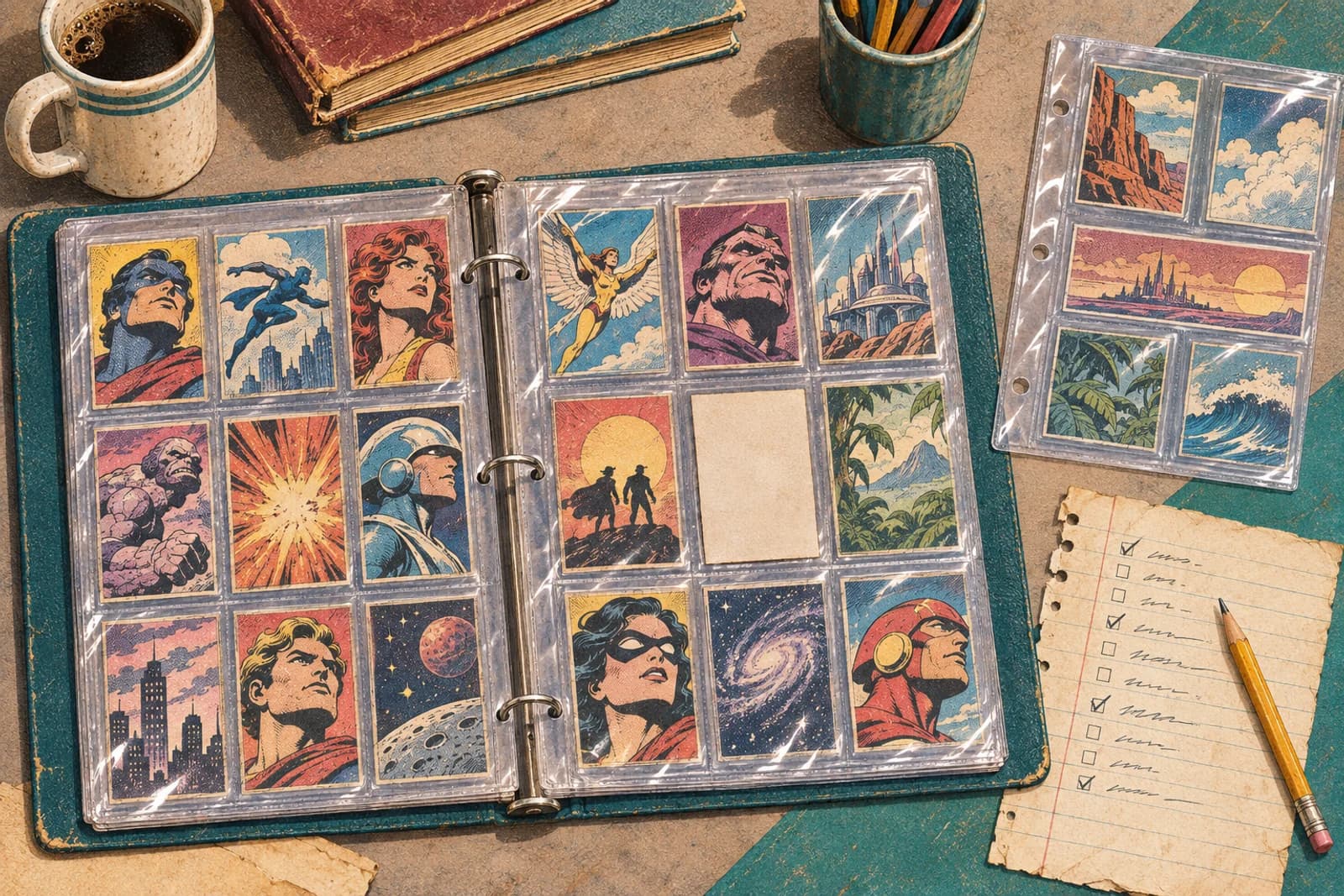
1. Decide What Complete Means Before Filling a Pocket
Suppose a binder contains 162 objects, among them three holograms and a Diamond-marked promo. It has the right-looking total and might even have no empty pockets. It still contains no more than 158 distinct base cards. Four objects belong outside the base count, and any duplicate among the remaining cards would lower that count further. If all 158 are different and correctly identified, four base numbers are missing. The three holograms might represent three of the five insert slots, but first match each hologram’s front to its MH checklist entry. Counting objects is useful for checking that nothing has gone astray; counting distinct checklist slots is what tells you whether the set is complete.
Use three separate lines in the binder index. The base line runs from #1 through #162, following the PSA Set Registry composition. That includes #161 Stan Lee and #162 Checklist as two cards, not one card and an optional piece of paperwork. The hologram line runs from MH1 through MH5, the five slots in PSA’s separate hologram composition. The appendix line covers whatever the owner has expressly chosen to document outside those two lists. It might include only promotional cards the owner can identify from both sides, or it might make room for packaging and unresolved pieces as well. The appendix is an inventory with a stated scope, not a third checklist with a denominator borrowed from the first two.
The number 167 is useful when it means one copy in each of the 162 base slots and one in each of the five hologram slots. It is also consistent with PSA’s retrospective reporting that a numbered factory tin contained the base set and all five holograms. That account describes a reported product configuration. It does not turn a binder of 167 cards into a factory set, and it does not establish that 167 is a definitive count for every object associated with the release. If a seller calls 167 cards a master set, the number is meaningful only after the seller says what was counted. An owner can use the same term for a broader collection, but the label does not tell the next reader which extras are required.
A card, a registry list and a seller’s description answer different questions. A legible card can show its number, subject and markings; it cannot by itself establish how many other slots were issued or how it reached its first owner. A modern registry composition tells you which slots the registry recognizes. It does not, by itself, document Impel’s entire production or promotional program. A seller’s description tells you what is being represented for sale. It is a starting point for checking the objects, not independent proof that all the stated slots are present. Likewise, the contributed images cataloged for Stan Lee and the checklist can help a reader recognize those two objects, but they cannot settle every question about their printings.
A cover line can state the rules without making a claim about what is already in the pockets: “1990 Impel Marvel Universe: base #1-162; holograms MH1-MH5; extras listed separately in the dated appendix.” Put actual progress on the index rather than embedding it in the scope. In the hypothetical binder, assuming every base card and hologram checks out as a distinct slot, that would read “Base 158/162; holograms 3/5; appendix: one identified promo.” Keeping progress apart from scope matters when a card goes out for imaging or a prospective identification falls through. Neither event creates a new checklist, even if it changes what the owner can count as confirmed or find in the binder that day.
Give the appendix a date and a short inclusion rule. For example, an owner might initially log only physically held promotional objects whose markings can be read. Later, the owner could add a subsection for photographed leads not yet in hand. The revision should say what changed: leads now appear in a separate subsection and do not count as holdings. If a card once thought to be regular proves to be a promo, move its record to the appendix and reopen the base slot unless another copy fills it. The total number of physical objects may be unchanged, but the base figure has to change. The contributed promo catalog’s practice of listing promotional entries apart from the regular set gives the owner a useful starting distinction without settling the status of every candidate.
The practical choice is whether the binder is being built to finish a numbered checklist or to document the wider release. An owner pursuing only base cards can mark the holograms as out of scope rather than call them five missing cards. An owner pursuing base plus holograms can report that goal as finished when both lines are full, even while appendix research continues. What neither owner should have to do is infer the rules from the last occupied pocket. A phrase such as “complete base, two inserts present, extras not audited” tells a reader more about the actual collection than “complete” written across a binder spine.
2. Turn the Base Checklist Into a Page Map
Number each viewable nine-pocket side of the binder, then decide whether the sequence or the subset headings will control the breaks. Here a side means nine positions visible from the front of that layout; turning the page to read the backs of those same cards does not create nine more positions. Give pockets a consistent order, such as left to right across the top row, then the middle and bottom rows. Once those conventions are written down, someone can use a location such as “side 6, pocket 7” without having to guess which face of a sheet or which corner the owner meant.
The subset map described in PSA’s historical account starts with Super Heroes at #1-51 and Super Villains at #52-81. Rookies occupy #82-87, Famous Battles #88-123 and Most Valuable Comics #124-136. Team Pictures follow at #137-148, then Spider-Man Presents at #149-160. Label the two closing cards individually: #161 Stan Lee and #162 Checklist. The numbering supplies the filing order; the headings tell a reader what kind of card to expect. For example, an index that says “Team Pictures, #137-148” offers a more useful way into the binder than a tab that says “Teams” without identifying where the group begins or ends.
In uninterrupted number order, the base cards fill exactly 18 sides. Side 1 holds #1-9; side 2 holds #10-18; side 18 holds #154-162. For any card, divide the number minus one by nine: the whole-number quotient plus one gives the side, and the remainder plus one gives the pocket. The first subset break shows how the system behaves in use. Side 6 spans #46-54. Its top two rows contain the last six Super Heroes, #46-51, and its bottom row opens Super Villains with #52-54. A tab on side 6 can point to that transition, but the index should give the exact starting pocket, since the tab by itself could suggest that #46 starts the new group.
Starting each of the seven subsets on a fresh side uses 22 sides, not 21, even when Stan Lee and the checklist share the final side. The seven subsets take six, four, one, four, two, two and two sides respectively, for 21 before the closing pair is filed. That pair needs one more. A 21-side layout is possible if one transition is allowed to share a side. For example, let the first three Super Villains sides run from #52 through #78. The fourth can hold #79-81 in the top row and all six Rookies in the next two rows. Famous Battles can still start fresh. Relative to a full reset, this arrangement saves the side that would otherwise be devoted to the Rookies.
Those layouts make different things easy. The continuous sequence lets a reader locate a number without consulting a custom map. It also uses all 162 positions, so no planned blank can be mistaken for an unfilled slot. Full resets let a reader open directly to the start of each subset, at the cost of extra sides and a lookup for cards whose addresses no longer follow the arithmetic. The 21-side compromise keeps most of those openings, but the index must make the shared Super Villains and Rookies side explicit. A reader who chiefly flips to battles or cover cards might choose the resets. One who often checks lots against a list of needed numbers might prefer continuous order and a few edge tabs.
Make a missing card look different from unused space. In the continuous layout, a hypothetical missing #52 gets a placeholder that says “Base #52, missing” in pocket 7 of side 6. Do not move #53 into pocket 7 to fill the row. A reader who checks only the first and last numbers in a run might not catch that once all the following cards have shifted. In a reset layout, the three pockets after #51 on its last Super Heroes side can be marked “unused by design” in the index. They are not missing cards and are not invitations to put the first villains there unless the map is deliberately revised. The two kinds of emptiness should not share a label.
Before filling the binder, try the map on a boundary and on the final side. In continuous order, #51 and #52 should be neighbors in pockets 6 and 7 of side 6; #161 and #162 should be in pockets 8 and 9 of side 18. In a layout with a dedicated closing side, put the two ending cards in pockets 1 and 2 and mark the remaining seven unused. A reset map is most useful when it names the first and last number on each side, not just the subset covering it. That way, a reader looking for #136 can tell where the cover cards end before opening the side labeled Team Pictures, and a binder with gaps still reads as a fixed sequence rather than an approximation of one.
3. Read the Backs Before Sorting by Character
An inventory search for the exact title Wolverine within Super Heroes should return three checklist entries before it considers duplicate copies. PSA’s composition places them at #10, #23 and #37. A search across the base run should also find Wolverine at #160 in Spider-Man Presents, and a broader subject search can bring up battles that feature him. If a collector makes a single row called “Wolverine” and puts a check beside it, those distinctions disappear. The adjacent X-Men entries at #139 and #140 present the same problem: a team name can describe both cards without identifying either one. Sorting by subject is useful for browsing, but only after the card number has been captured as part of each record.
The reverse is also worth reading for what the set says about its characters. PSA’s retrospective account describes character backs that give affiliations, comic appearances and win-loss records. Those fields show how Impel presented characters at the time. They are not live statistics or a current guide to which team a character belongs to, and a tally on the back should not be treated as an independently established count of every story. When transcribing a detail, label it as a statement printed on that card. A later reference that describes a character differently may prompt a note, but it is not grounds to overwrite the printed wording or change the checklist identity.
What you need from a back depends on the subset. For a character card, the basic identity check is the number and the title as printed; the affiliation can be entered as a separate descriptive field if it is useful to the owner. For a Famous Battles entry, retain the full printed title. If it names a matchup, keep both sides in the order printed. If it names an event, such as Atlantis Attacks, keep the event title rather than forcing it into a matchup format. For a team picture, record the number even if the title already names the team, and describe a visible distinguishing feature only if it helps match the specimen to its images. Do not infer a roster from another card bearing the same team name. The object being inventoried is one particular team picture, not the team in the abstract.
A reliable key has five parts: year, maker, issue, class and number. A plain-text example is “1990 | Impel | Marvel Universe Series I | Base | 010.” The leading zero makes a simple text sort work; a separate printed-number field can preserve the number as it appears on the card. The maker and year are not redundant with the words “Marvel Universe.” The Smithsonian’s finding aid inventories 1987 Comic Images Marvel Universe Series 1 separately from the 1990 Impel material. Its purpose is to describe archival holdings, not to establish each card’s number, but it demonstrates why a short series name cannot carry the whole identification. The class field likewise keeps the base list from becoming a catchall for anything with the same artwork or character.
Keep the printed subject and catalog wording in separate fields, neither of them part of the key. For example, PSA calls #111 “Spider-Man vs. Green Goblin.” Suppose an older spreadsheet records that same card as “Spiderman vs Green Goblin.” Once the object’s identity is confirmed, changing the spreadsheet title does not add a second card or open a second checklist slot: both records point to “1990 | Impel | Marvel Universe Series I | Base | 111.” If the older record contains wording from an invoice, leave it in an invoice-description field rather than presenting it as a transcription. The same distinction helps when a catalog shortens a name for display. Printed wording records what the object says; catalog wording records how a reference lists it.
Separate the slot from the physical copy as well. In a hypothetical collection with two copies of #10 and one of #23, the inventory needs two checklist rows and three specimen records. Both #10 specimens link to the same slot and can have different locations or reverse photographs. The #23 specimen links to its own slot, and #37 remains missing, no matter what a search for Wolverine turns up. If the collector replaces the binder copy of #10 with the spare, the selected specimen changes but the number of confirmed slots does not. Giving each physical copy a short local identifier makes that swap legible without appending a homemade suffix to the checklist number that someone else could mistake for a published variety.
A front-only image sometimes supports a subject tag but not a confirmed slot. Suppose a loose X-Men card is photographed clearly from the front, while the reverse image is cut off where the number should be. Unless the visible evidence already distinguishes the entry reliably, file it under X-Men with the number unresolved rather than checking off #139 or #140. Then ask for a readable back and compare the resulting identification with the existing records before moving the card to its numbered pocket. That preserves both uses of the inventory: a character collector can retrieve everything filed under X-Men, while a checklist collector can tell which of the two numbered team cards is actually accounted for.
4. Separate the Cover Card From the Comic It Pictures
The number on a Most Valuable Comics card tells you where the card belongs in the Impel binder. The number on the cover it reproduces tells you which comic it pictures. On the Fantastic Four entry those numbers are #124 and #1. On the Amazing Fantasy entry they are #126 and #15. Neither number is an alternate way to write the other. If you own only the cards, your inventory should show two cards and two references to comics, not two comics in the collection. If you own one of the books as well, it gets its own record and a link to the card that pictures it.
Set up two columns in the index. Call the left one “Trading card: maker, set and base number” and the right one “Comic depicted: series and issue.” The column headings matter more than shortening the entries to fit on one line. A column called simply “Number” invites a reader to enter the comic’s issue number where you expect the card’s checklist number. The two rows can be transcribed like this:
Trading card: 1990 Impel Marvel Universe, base #124. Comic depicted: Fantastic Four (1961) #1.
Trading card: 1990 Impel Marvel Universe, base #126. Comic depicted: Amazing Fantasy (1962) #15.
The numbers in parentheses identify the comic series. They do not date the card or establish the edition of a book carrying that cover. Marvel’s reading guide identifies Fantastic Four (1961) #1 and Amazing Fantasy (1962) #15 as comic issues and describes the latter as Spider-Man’s first appearance. That is a claim about the character’s debut in comics, not about the earliest trading card to feature him. Likewise, a book from a different Fantastic Four series can be numbered #1 without being the issue pictured on #124. A reprint presents a different problem: it can reproduce the correct cover and issue number while still being a later edition. Matching the cover settles what is depicted, not which physical edition you have.
“Most Valuable Comics” belongs in the card record as Impel’s subset name. It tells a reader where to look in the binder and how the set grouped these cards. It is not a present-day appraisal of either the cardboard or the book. A copy of #126 with sharp corners and a book with that same cover and a detached cover would not share a condition assessment, much less a valuation, simply because one pictures the other. Nor does a missing #126 become an owned slot because the collector has the actual comic. Keep the cross-reference visible, but let each record answer questions about its own object.
Consider a hypothetical collection with base #126 in the binder and a loose comic offered as Amazing Fantasy #15. Give the book its own specimen ID, such as COM-001, and its own location. In the identity record, enter “Amazing Fantasy (1962) #15, issue depicted; edition of this copy not yet verified.” Save a cover photograph and, if the book can be opened safely, an image of the interior publication statement. Suppose that statement is legible and explicitly identifies the specimen as a later reprint. Transcribe the edition wording there and save the image filename next to it. The specimen record can now say “reprint,” while the card’s depicted-issue field still says Amazing Fantasy (1962) #15. If the statement is missing from the photographs and all you have is a seller’s description of an original, retain that wording as a seller claim rather than upgrading the edition field.
Record the book’s condition separately from that edition evidence. For the hypothetical loose copy, “lower cover corner creased; interior not fully examined” describes an observation and its limit. A photograph of a few interior leaves does not establish a professional page-quality designation, and the absence of an obvious repair in a picture is not a finding that the book is unrestored. If an independently held comic is CGC-certified, give its comic condition grade, page-quality designation and any restoration designation separate fields for the exact reported wording. Mark fields you cannot read or verify accordingly. CGC publishes comic condition, page-quality and restoration scales and directs card collectors to a different scale. None of those comic fields carries over to the linked Impel card.
The cross-reference also dictates what to request when a listing is ambiguous. If the goal is to fill base #126 and the seller shows only the cover artwork, ask for the card reverse with the Impel identification and checklist number readable. If the goal is to identify an independently offered comic edition, ask instead for evidence from the book’s publication details or, for a certified specimen, readable holder information. Those requests resolve different uncertainties. The same Amazing Fantasy image can appear in both records without doing the evidentiary work of either.
5. Stan Lee #161 and the Difference Between a Report and a Verified Variety
PSA’s base composition has one slot for #161 Stan Lee. The scan indexed by the Trading Card Database shows a reverse with a Stan Lee nameplate and no Spider-Man Presents heading. An independent hobby checklist reports upside-down Spider-Man Presents printing on a #161 back, but does not say whether only the heading or more of the reverse is affected. The scan documents one example, and the checklist gives you something to look for. Neither establishes that a grading service recognizes a separate variety, that Impel ran a dedicated batch, or that one version preceded or corrected the other.
Check what is printed on the entire reverse before judging its orientation. If Spider-Man Presents is visible, look at the surrounding text and number: is the heading inverted relative to the rest of the printing, or is the layout itself different from the Stan Lee example? A rotated photograph turns all the printing together, and a tight crop of a heading cannot show its relationship to the rest of the back or to the front. Ask for both faces of the same card, with the same physical edge kept at the top, before describing what is inverted.
For a specimen in hand, start with square-on photographs of the entire front and back, with all four edges visible. Place a removable top marker beside the card, not on it, and flip the card left to right so that the edge you called the top stays at the top of the frame. Keep the orientation convention the same for any comparison copy. Preserve the full photographs, even if you later rotate a copy of an image to make the text easier to read. For the reverse detail, include both the heading and an independently readable line of body text or other fixed printing. That gives a second reader a way to check the relationship within the image rather than relying on your filename or description.
Suppose a seller sends a clear Stan Lee front and a reverse photograph that reads correctly after you rotate the whole image. If the reverse shows the Stan Lee nameplate and no Spider-Man Presents printing, note that the supplied image does not show the reported feature, assuming the photographed back belongs to that front. If a different full reverse shows Spider-Man Presents printing, transcribe what is visible and specify what it is inverted relative to: other text on the same face or, if the photos preserve the same physical top edge, the front. That documents the specimen, not an official label, a distribution pattern or the number of such copies that survive.
Use separate fields for the base identity and the evidence status of the feature. For a specimen already identified as #161, a hypothetical entry might read “Base identity: #161 Stan Lee, confirmed. Reported feature: upside-down Spider-Man Presents printing on the reverse; extent of inversion unclear. Status: unresolved; seller supplied a crop only. Next evidence needed: full front and reverse of the same card, with the same physical edge at the top.” If you later obtain adequate images, change the status and retain the earlier note with its date. If you have two physical copies, link both specimen records to #161 and identify which one sits in the binder. The feature can be documented on one and absent on the other without creating a 163rd base slot. If you add a cross-reference in the appendix, do not count that link as another object.
Keep the scope of any comparison narrow. Two clear, different reverses would be evidence of a difference between those specimens. They would not tell you how often it occurs, whether either example came from an earlier production run, or how a grader would label a submission. Avoid putting “corrected” or “error printing” into the issue field just because a seller uses those terms. If the terms help you retrieve the listing, preserve them as listing wording. The more useful description for the next person is a literal one: what is inverted, relative to what, and in which image it can be seen.
Check #162 separately. PSA lists it as the Checklist, and the contributed gallery indexes its images apart from Stan Lee’s. Its function as a list does not make it dispensable when counting the base cards. Suppose your copy has pencil ticks beside some entries. Once you have identified the card, record the ticks and their location in the specimen’s condition notes. PSA’s grading guidance distinguishes marks from the other factors it considers; that is reason to classify the observation, not to predict a result or rename the card a “marked checklist variety.” If an unmarked copy takes its place later, the selected specimen changes. The last two base slots still represent two objects by design: #161 for Stan Lee and #162 for the Checklist.
6. Identify MH1 Through MH5 Without Borrowing Base Numbers
Give the holograms their own numbered key. PSA’s Set Registry lists them as a separate five-card composition, not as five substitutions for cards in the base set. The key uses the registry identifiers with normalized subject names. The contributed scans of Cosmic Spider-Man and Wolverine show the same reverse checklist with all five codes. Seeing MH4 on a back therefore does not by itself identify a Wolverine hologram. Match the subject on the front to the checklist, and use the back to corroborate the issue. The key does not establish insertion odds or resolve reported differences in reverse orientation.
MH1: Cosmic Spider-Man.
MH2: Magneto.
MH3: Silver Surfer.
MH4: Wolverine.
MH5: Spider-Man vs. Green Goblin.
The base list explains why a character name is insufficient even when it is specific. Cosmic Spider-Man can point to base #30 or hologram MH1. Spider-Man vs. Green Goblin can point to base #111 or hologram MH5. An owner with #111 and MH5 holds two checklist identities, not two specimens of the same numbered card. An owner with only #111 cannot check off MH5 just because a search for the matchup returned a result. Keep a subject link if you like looking at the two portrayals together, but make that link run between the records rather than merge them. A combined character view and an insert-only count can then coexist without either inventing a card or dropping one.
Record the printed front subject, the normalized checklist identifier and the seller’s wording separately. Imagine an invoice says “Cosmic Spidey holo, MH-1.” Keep that wording as the invoice description. If the front identifies Cosmic Spider-Man and the reverse matches the 1990 hologram issue, enter MH1 as the normalized identifier. If you transcribe the code, note that it appears in the shared reverse checklist, not as a number uniquely labeling this copy. If the front subject or the reverse details cannot be read, say what is missing rather than letting the invoice establish the slot.
That separation makes it easier to diagnose a listing headed “#30 Cosmic Spider-Man Hologram” with only a straight-on front photograph. Do not silently translate #30 to MH1 on the strength of the word “hologram,” or assign the object to the base set on the invoice number alone. Request a full reverse and, if needed, an angled front view that shows the subject and holographic finish. A base reverse numbered #30 or a Cosmic Spider-Man hologram front paired with the 1990 shared hologram back supports a different classification. Keep the original listing wording, and leave both slots unconfirmed if the photographs do not resolve the conflict.
A dedicated nine-pocket side can display all five holograms without creating four apparent vacancies. Put MH1 through MH3 across the top row and MH4 and MH5 in the first two positions of the middle row. In the page index, mark pockets six through nine unused by design. If MH3 is actually missing, give pocket three a placeholder reading “MH3 Silver Surfer, missing.” The distinction is visible even with the page half empty: pocket three has an assigned card, whereas the last four pockets were never assigned insert numbers. Keeping a simple run of five also makes the page easy to check against the registry list. A collector who prefers a symmetrical display can use a different arrangement, but the index then needs the five explicit pocket addresses.
An independent hobby checklist reports an MH5 reverse-orientation difference. Treat that as a lead for comparing physical examples, not as a sixth hologram position or a grading attribution. When photographing a candidate, declare which front edge is the top, take a square-on picture, and flip the card left to right without moving that edge to the bottom. Photograph the full reverse in the resulting position, with a top marker outside the card if needed. Apply the same procedure to a comparison copy. A pair of seller images in which the front and the back have each been rotated to read upright may be useful for identifying MH5 but cannot, by themselves, show how the reverse sits relative to the front.
Suppose the only difference you can see between two listings is that one back image is upside down on screen. Record the insert identification if the front subject and issue are clear, but leave the orientation report unresolved: the images do not show the direction of the flip. If a consistent photo sequence later shows a difference, describe it relative to the recorded front edge and preserve the original files. Do not infer which orientation came first or which is scarcer. A confirmed MH5 still fills one slot whether or not the orientation question is settled; a second specimen with a different documented orientation can have its own record without creating an additional numbered slot.

7. Inspect the Holographic Surface Without Grading It by Eye
Start with two photographs that answer an identity question, not a condition question. With the hologram supported flat in its existing sleeve or holder, position the camera square to the card and use broad, even light. Frame the entire front, including the subject, corners and surrounding border. Then photograph the entire back so the shared insert checklist and other issue printing can be read. The front image may not bring out the holographic effect, and that is fine. It gives you a reference for where a feature sits relative to the card edges. Keep these views even if a more dramatic angled photograph is the one you choose for display.
For the surface sequence, move the light rather than repeatedly picking up and tilting the card. Take an oblique-light view from one side, repeat from the other, then change the camera angle slightly if the initial views leave something unclear. Keep enough of the card in frame to locate any detail later. A crop of a bright streak may look convincing on its own, but without the adjacent border or another fixed landmark it can be difficult to tell whether two photographs show the same place. Note which direction the light came from, and keep an uncropped original with each detail view. Nothing in this sequence requires touching, rubbing or tracing a feature on the card.
Consider two hypothetical copies of MH4 Wolverine. In their square-on views the visible image on copy A appears closer to the left edge than on copy B. Before describing that as a centering difference, compare the same visible boundary on both cards under like lighting. If the only thing that seems to move is the bright part of the holographic image as the lighting changes, that is a poor centering reference. If a fixed image boundary can be compared against the card edges and still appears offset, record the observation as apparent image placement. Do not substitute that description for a measurement you did not take or a grader’s interpretation of what counts as centered on the issue.
Now suppose copy A shows a fine line near the right edge. It becomes almost invisible under even light, but it returns at the same position relative to the border in two angled photographs. A separate bright band sweeps toward the corner when the lamp moves. The fixed line and the moving band deserve different notes: one is a persistent visible feature with an undetermined cause; the other behaves like glare. Persistence alone does not identify a scratch, much less a roller mark. Conversely, a line visible at only one angle is not automatically glare. The useful distinction is what changes position, what changes only in visibility, and what the photographs cannot establish.
A sleeve can carry a fine scuff over an otherwise unobstructed area of the card, and a rigid holder can add reflections that obscure the boundary you are trying to compare. An angled view may help if a line clearly continues onto the plastic beyond the card edge. If it stops within the card outline, that does not settle which surface it is on. Do not open a sealed holder to settle the question. For a housed raw card, leave it in place if removal would require dragging it past a tight opening or handling the reflective face. An inventory note can stay precise without identifying the layer: “Fine diagonal line near upper right, fixed relative to border in two angled views; sleeve or card surface not determined.”
PSA’s retrospective reporting includes collector accounts of roller marks, scratches and centering problems. Those accounts suggest where to look, not what to call every line or offset. They do not establish how frequently a feature occurs, and they do not diagnose either of the hypothetical Wolverines. PSA publishes card grading standards that consider centering and surface-related qualities alongside other criteria. CGC Cards publishes its own scale. Neither set of standards turns a photograph with uncontrolled reflections into an assigned grade. If you cannot distinguish a plastic scuff from a mark on the card, leave that distinction open instead of estimating how many points it would cost.
The decision about which copy to display can be narrower than the question of which would grade better. Suppose copy B shows the Wolverine image more clearly under the binder’s usual reading light, but copy A has a back you prefer and a line you cannot place. If the binder is for viewing the fronts, you can select B for that reason and retain A’s observations without calling either the higher-grade card. If you are evaluating a listing rather than cards in hand, ask for one additional view that addresses the uncertainty, such as the upper-right area lit from the opposite side with the full card edge included. If that view never arrives, note the inspection limit. The MH4 identity, the appearance you prefer and the condition question do not need to share a verdict.
8. Read the Promo Reverse Even When the Number Matches
A seller offering a Spider-Man #29 may have supplied the right subject and number without identifying the right object. The contributed Trading Card Database promo catalog lists a Diamond-marked Spider-Man #29, while PSA’s regular composition has a Spider-Man at #29. The number and character therefore do not decide whether the card fills the base pocket. A readable reverse lets you compare the mark and surrounding printing with an identified example. Asking only for a closer picture of the number can leave the decisive part outside the frame. Ask for the whole back first, then a detail of the logo or wording if it is too small to read.
The Amazing Fantasy cover makes the opposite trap visible. The contributed promo catalog puts the Diamond-marked Amazing Fantasy #15 at card #125. PSA’s regular checklist puts that cover at #126 and assigns the regular #125 to X-Men #1. A cataloged promo #125 and a regular #125 can thus picture different comics, while two versions featuring the same Amazing Fantasy cover can carry different card numbers. If you enter #125 from a seller’s description before checking the back, you might appear to have filled the regular X-Men slot with a card that depicts Spider-Man’s debut issue instead. Correcting the subject alone would not fix the class or number.
Use one row per specimen rather than one row per title. The comparison below models a working sheet for four hypothetical specimens with readable title and number fields, plus a fifth seller lead. The Diamond mark is a visible clue, not a transcription of distribution wording. Where no such wording has been transcribed in the example, the field stays open rather than borrowing language from a hobby index.
Printed title Printed card number (or none) Logo or mark on reverse Distribution wording Source confidence
Spider-Man #29 No Diamond mark seen Not transcribed Regular identification supported by full reverse comparison and PSA composition
Spider-Man #29 Diamond mark visible Not transcribed Consistent with contributed promo entry; distribution unverified
Amazing Fantasy #15 #125 Diamond mark visible Not transcribed Consistent with contributed promo entry; distribution unverified
Amazing Fantasy #15 #126 No Diamond mark seen Not transcribed Regular identification supported by full reverse comparison and PSA composition
Amazing Fantasy #15 (cover text only) Not visible; seller says #125 Reverse not supplied Not visible Unresolved; front image and seller description only
In an actual sheet, transcribe the wording you can read, including any punctuation or abbreviation that differs from a catalog title. Use “none printed” for the number only if the whole relevant area is visible and you can establish that it really is unnumbered. “Not visible” means the evidence is missing or inadequate. The same distinction applies to a logo: a clear full reverse with no Diamond mark visible is different from a glare spot or crop where the mark might be. Nor is the absence of that mark a universal test for regular cards. Compare the rest of the reverse and the set identification rather than accepting any unmarked back automatically.
Hobby indexes can help you find comparison specimens, but they need not agree on a number or the name of a promotional group. The independent checklists describe Diamond-related singles and panels, and one explicitly flags number changes between promos and regular cards. When two entries appear to conflict, copy each claim into a reference note and check whether they describe the same object at all. One might index a design within a panel while the other describes a single, or one might use the regular issue’s number as a cross-reference. Those are possibilities to test against legible images, not explanations to assume. Let the printed number and mark determine what you transcribe, and leave an unresolved catalog name out of the confirmed identity field.
Take the last row in the comparison. The seller says the cover card is a Diamond #125 but sends only the front. You can record the visible cover and the claim, but you cannot verify the Diamond mark, the printed card number or the status of the piece from that photograph. Ask for the complete reverse of the same specimen. If the response shows a regular #126, correct the inventory identity and retain the original seller wording as part of the acquisition record if you proceed. If no reverse comes, leave it in the lead file rather than treating low-confidence evidence as an owned or missing base slot. A collector who wants Diamond-marked examples can define that appendix narrowly and expand it as evidence improves. Neither these comparisons nor an index’s list length establishes one mandatory promo count, and a design that resembles a base card is not necessarily a base parallel.
9. Keep Panels, Toy Biz Crossovers and Unverified Paper in an Appendix
An intact panel belongs in the inventory as one physical piece, even when it carries more than one card design. An independent hobby checklist reports a two-card panel featuring Hulk and Silver Surfer. If a specimen can be matched to that description from images of both sides, give it one appendix identifier and link Hulk and Silver Surfer as subjects. A search for either character should retrieve the panel, but an object count should return one. Record the arrangement of the designs as seen and photograph the whole piece, including the join and all outside edges. Tight images of the individual designs can supplement that record, but they cannot establish that the two designs are still joined.
A practical entry for a hypothetical example could read “AP-012; intact two-design piece; Hulk and Silver Surfer; front and back photographed together; distribution not independently established.” Attach any printed numbers or wording to the design or area where they appear. If only one design is numbered, do not copy that number to the other, and do not give the panel itself a published number unless the object supports one. A base-card number can be useful as a link to similar art, but it does not identify the panel. This lets a reader browse the related cards without mistaking the panel’s two subject links for two occupied base pockets.
A loose piece offered as a cut from that panel is a separate identification problem. Photograph its entire front and back, record its dimensions, and note the appearance of the edge said to have been cut. Compare the visible printing and layout with evidence from the intact panel, if available. Even a close match need not tell you when or by whom the piece was separated. A rough edge alone proves little about the original format. If the evidence is limited to a seller’s description and familiar artwork, write “loose piece; seller attributes to Hulk and Silver Surfer panel; origin unverified.” If the loose example sits alongside the intact panel in your collection, it is one additional specimen, not a third design on the panel or a replacement for either design.
For Toy Biz material, the front and back can point to different parts of the Marvel Universe run without contradicting each other. Independent hobby checklists describe pieces with Series I artwork and 1991 backs advertising Series II. Photograph the back, transcribe the promotional wording and any visible date, and record the front artwork as a separate link. In a hypothetical listing titled “1990 Series I Toy Biz card,” the image may support a Series I artwork link, while a legible 1991 Series II promotion supports a different classification for the object. Do not let either the listing title or the artwork override the printed evidence. If the seller shows only the front, record the resemblance and leave the Toy Biz attribution pending a readable back.
An oversized item offered as an Impel checklist needs a record that can survive a change in attribution. Measure its height and width and state the units; avoid guessing from a photo with nothing for scale. Photograph both sides and the edges, and transcribe the title, any card numbers, logos, dates and other markings that are actually present. If one side is blank, say so only after seeing it. Note whether its list reproduces the same entries as the standard checklist or merely looks similar in the portion you can read. A match in wording would be evidence of shared content, not proof that Impel produced or distributed the larger piece.
Keep provenance separate from those physical observations. For example, an owner might have a receipt for an oversized sheet sold as a dealer handout. The receipt documents how the owner acquired it and what it was called at sale. Without corroboration, it does not document how the sheet reached the dealer, much less a distribution program. Save a dated copy of the listing or receipt and mark the claimed distribution unverified. An independently documented matching specimen or contemporaneous distribution material would address a different question from a sharper image of the same sheet. Until you have something that supports the claim, a record headed “oversized checklist-like sheet” is more informative than one that names a distribution channel as fact.
Give these specimens physical addresses that do not depend on their proposed identities. A panel or oversized sheet stored flat outside the binder can have a reference slip in the appendix index that lists its dimensions, specimen ID and storage location. The slip is not another collectible. If later evidence changes a loose piece from “panel origin unverified” to a stronger attribution, you can update its classification while keeping the same physical address and acquisition trail. None of these records fills regular #162. PSA lists that checklist as a base card, and the contributed gallery indexes front and back images of it as a distinct object. If the only checklist in hand is the oversized sheet, keep the sheet findable in the appendix and leave the numbered base slot open.
10. Log Wrappers and Tins Separately From Their Contents
A Wolverine wrapper identifies the subject printed on the packaging, not a Wolverine card inside. PSA's retrospective account of the 1990 Impel release reports three wrapper subjects: Wolverine, Spider-Man and Captain America. Give the wrapper its own record even if it arrived with cards. Start with the object type, the visible subject, any legible product wording, and whether the wrapper is empty or still around a pack. Photograph enough of both sides to show the printing and any opening or seam you describe. If your aim is to document the three wrapper subjects, that is a packaging checklist. Finding the Captain America wrapper does not change your base count, and finding a second Wolverine wrapper does not establish anything about the assortment inside either one.
An empty wrapper and a pack represented as unopened need different descriptions. For the wrapper, record the opening and any material that is missing if you can see it. For the pack, preserve the seller's unopened claim separately from visible observations: which seams are pictured, whether the ends are obscured, and whether the packaging has damage you can locate. A photograph with both ends visible is more useful than a close-up of the character art, but it does not reconstruct the pack's history. If you elect to keep the pack closed, record the contents as unexamined. You can count the pack as one packaging specimen without crediting yourself with any particular card or treating the decision to leave it closed as an identification failure.
PSA reports a configuration of 36 packs per box and 12 cards per pack. Multiplying those figures gives 432 nominal card positions for a box in that configuration. It does not give 432 distinct cards, establish how many copies of a given base number are inside, or show whether a particular sealed box contains all 162 base numbers. It does not establish an insert count, either. PSA's retrospective includes hobbyists' expectations for holograms per box. Those expectations are collector accounts, not Impel's published insertion odds or the results of a controlled collation study. A seller who uses the reported box configuration in a description has not thereby made a supported claim about the inserts in that box.
If you open a hypothetical box to document what it yields, label the box and assign an opening record to it before the cards are mixed with other holdings. You can record whether each pack was present, which wrapper it used, and what was actually found, then link the card records to the opening record. If the box arrives partly empty, state how many packs were present rather than extending the results to the absent packs. If an earlier owner already combined its contents with another box, record the association as reported rather than reconstructing a pack-by-pack list. Even an opening documented from start to finish measures the contents of the box you opened. It cannot tell a reader what the next box will yield.
Use a separate record for a tin and its claimed factory contents. PSA reports that a numbered factory tin contained the 162 base cards and five holograms. For a listing described as an unopened factory tin, transcribe that claim, record where the visible number appears, and note what the images do or do not show about the closure. The number belongs to the container record; it is not a card checklist number or proof that the tin retains its initial contents. For an opened tin, request images that establish which cards are present: readable base numbers and distinct hologram fronts matched to the MH checklist, with reverse views to corroborate the issue. A photograph of several stacks next to a tin can show what is being offered together without showing either the full assortment or where it came from.
Suppose a numbered tin has good evidence supporting its identification as an original container. Its owner says two scuffed base cards and MH3 were replaced years after the tin was opened. An audit confirms one card for every base number and every MH identifier. Enter the container identification on the tin record, document the disclosed replacements in the acquisition history, and record the contents as an assembled, audited set of 162 base cards and five holograms. Those findings are compatible. The replacements do not make the container less genuine, and the genuine container does not make the replacements original to it. For the remaining cards, use only the provenance the owner can support. A general account of replacements is not proof that every other card can be traced to that tin.
Decide which record needs the next piece of evidence before pursuing a purchase. If you want a wrapper specimen, a readable photograph of the printing and opening may answer what you need without a claim about cards. If you want a factory-associated group, an owner who can document custody addresses a question that a complete checklist cannot. If you primarily want to finish the binder, ask instead for the card numbers that would change your holdings. Put a physical location on the tin or wrapper record, and link it to the cards only to the extent the evidence supports. That way, moving an audited set out of a tin changes where the cards are stored, not what the inventory says about their origin.
11. Tell Series II, Later Marvel Universe Sets and Reproductions Apart
In a mixed stack, pull out any card numbered #1 before filing the run behind it. In the 1990 Impel base composition, #1 is Captain America. An independent checklist for the 1991 Impel series lists Spider-Man at #1. That comparison is quick, but it works because you are checking the number and subject together against two specified issues. It does not mean that every Captain America card belongs to 1990 or that every Spider-Man card belongs to 1991. For the checklist card, even the number and generic subject can fail to distinguish the issues: both series use #162 for a checklist. Read the issue identification and compare the entries printed on the card before treating a checklist in a mixed lot as the one missing from your binder.
The first hologram gives you an additional test. PSA’s 1990 insert composition identifies MH1 as Cosmic Spider-Man. The independent 1991 checklist lists Spider-Man at H-1. When a seller writes “Spider-Man hologram 1,” ask for both faces: match the front design and subject, then compare the reverse printing with the appropriate release. The MH and H prefixes are useful in catalog records, but the 1990 reverse prints the full MH checklist, so a crop showing MH1 alone could come from a different insert in that release. Keep the seller’s wording in the listing record without reducing the normalized identifier to the numeral 1.
Make a side-by-side reference keyed to the printed clues most likely to show up in short listings. The numbers below are reference identifiers, not a substitute for reading the specimen. For a card offered as a parallel, use the appropriate checklist and look for the physical distinction that supports the seller's classification.
Issue Base starting clue Base scope or endpoint Separate class to check
1990 Impel Marvel Universe #1 Captain America #162 Checklist MH1 Cosmic Spider-Man, first in the separate five-hologram composition
1991 Impel Marvel Universe Series II #1 Spider-Man #162 Checklist, so that number alone does not date it H-1 Spider-Man, as listed by the independent Series II checklist
2011 Rittenhouse Marvel Universe #01 The Korvac Saga Manufacturer lists 90 base cards Manufacturer lists a separate 90-card parallel run and groups numbered inserts separately
Rittenhouse's 2011 manufacturer checklist makes the difference between an issue and a class especially useful. A card offered as “Marvel Universe #01” might belong to that product if the subject and printing line up with The Korvac Saga. Once you place it in the product, you still need to establish whether a seller's parallel claim is supported. The manufacturer's explicit separation of the 90-card base and parallel runs tells you that those are two checklist categories. It does not tell you which one you are seeing in a photograph that omits the relevant detail. The same checklist groups numbered inserts such as Marvel Originals apart from those runs. Do not apply that classification retroactively to the Impel cards just because the products share a title.
The Smithsonian's finding aid offers a useful check on names that look more specific than they are. It inventories 1987 Comic Images Marvel Universe Series 1 separately from 1990 Impel Marvel Universe and 1991 Impel Marvel Universe Series II. It also separates 1992 Sky Box Marvel Universe Series III from 1992 Sky Box Marvel Masterpieces material. These are records of the museum's holdings, not a list of every format or card that was issued. For a collector, their value here is that they show why “Marvel Universe” and even “Series 1” are insufficient as unique names. Enter the year and maker alongside the series wording. If the photos or the printed material do not support those fields, leave them open rather than picking the record whose title best resembles the listing.
Artwork can also be reproduced long after the issue it identifies. The publisher listing for Dark Horse Books' Marvel Universe Gallery: 1990-1994 Trading Card Collection describes a book reproducing cards across that run, including inserts, and lists October 27, 2026 as its publication date. A reproduction in that book can help a reader recognize an image or locate a design for comparison. It is not an original card, and the publisher's description of the book's scope does not prove that it covers a disputed variety. If a listing uses an image clipped from a reproduction or does not show what kind of object was photographed, ask for both sides of the actual item with the edges in view. A recognizable picture establishes less than a photograph of a particular object.
For a hypothetical lot titled “Series 1 complete with holograms,” suppose the seller initially shows Spider-Man #1, a front view of checklist #162 and an insert described simply as “1.” Record the first card as consistent with the 1991 starting slot, subject to issue confirmation, and keep the checklist and hologram unresolved. Ask for a readable back of the checklist, both faces of the hologram, and sequential images of the numbered run if completeness matters to the purchase. You need not presume the lot is entirely 1991 just because one card points there. If the owner combined two sets, identifying each object keeps a genuine 1990 card from being rejected merely because it came in a stack advertised under the wrong name.
12. File Iron Man Movie Cards Under Their Own Checklist
A search for Tales of Suspense #39 can turn up three different things a collector might reasonably want: the Marvel comic issue, a 1990 Impel cover card and a Rittenhouse film-product insert. The shared words identify the comic being referenced, not the physical object on offer. On the book, #39 is the issue number. On the Impel card, the number that fills a binder slot is #135. On the Rittenhouse card, it is AR1, an identifier within an insert group. A title search can link all three records, but the links must leave room for a collector who owns any one of the objects without owning the other two.
For character collecting, make the reference run in both directions. Start with a subject entry for Tales of Suspense #39. Under it, list the comic and the two checklist entries, each with its own maker, publication or product, object type and numbering field. Conversely, a search for Impel #135 or Rittenhouse AR1 should retrieve the description of the depicted issue without presenting that description as another item in hand. A working cross-reference can read as follows. The comic row is an issue reference until you have evidence identifying an actual copy and its edition.
Maker or publisher Publication or product Object type Issue or checklist identifier
Marvel Tales of Suspense Comic book Issue #39; record edition separately for a held specimen
Impel 1990 Marvel Universe Base trading card, Most Valuable Comics subset Base #135; depicts issue #39
Rittenhouse Archives Iron Man Movie Trading Cards Iron Man Archives insert AR1; depicts issue #39
Rittenhouse's manufacturer checklist supplies the distinction a short auction title can hide. It lists 70 cards in the movie base set, beginning with the title card and checklist at #01. It places Tales of Suspense #39 in the Iron Man Archives insert group as AR1, not among those 70 base cards. The fact that AR1 presents comic-cover material rather than a movie image does not make it unrelated to the film product. Its place in the insert program is what associates it with that product. Equally, a seller can correctly call AR1 an Iron Man movie card while being wrong to say it completes a numbered position in the movie base run. If the intended purchase is film base #01, the title and checklist card is the one to verify.
If the manufacturer states an insertion rate for a group, record it in the product reference with the group name and the unit. Do not enter a group rate as AR1’s individual odds. A box result is a separate kind of information. Suppose a collector logs an opening and finds one Iron Man Archives insert, but it is not AR1. That documents what appeared in that opening, not the insertion rate or the presence of AR1. Conversely, a photographed AR1 can help identify that specimen without establishing how many packs were opened to obtain it. Neither an insertion rate nor the contents of a film box belongs in the Impel total.
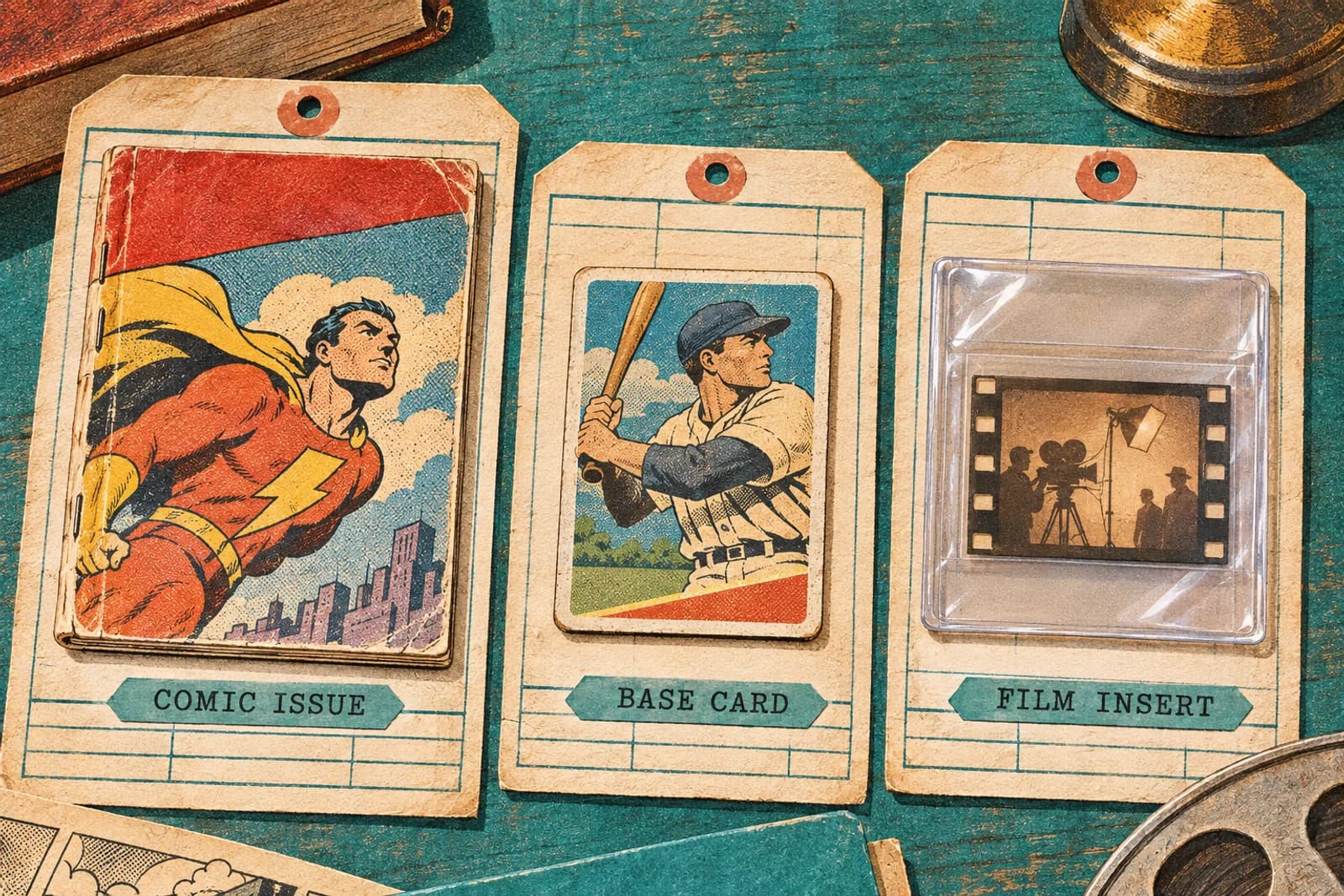
Suppose a listing says “Tales of Suspense #39, Iron Man, #135/AR1” and supplies only a crop of the cover art. Record the cover subject as visible and the object type as unresolved. Ask for the whole front and back of the item, including the edges and legible product and number information. If the response identifies the card as AR1, enter that in the Iron Man Archives group and preserve the combined wording as the seller's description. Do not enter #135 as an alternate card number. If the photographs instead identify a book, ask for the evidence needed to determine the edition. A larger photograph of identical cover art may confirm what the image depicts without showing whether the book is an original issue copy, a later edition or even the specific item the seller intends to ship.
If the book is certified, describe its holder and condition in the comic specimen record. CGC's comic documentation separates standard condition, page quality and restoration, three fields that should not be copied to either cover card. Likewise, card condition or certification is specific to the slabbed or raw card in question, not to the comic it pictures. Place each specimen's location next to its own record: for example, the Impel binder pocket for #135, a film-insert storage page for AR1 and a separately recorded address for a confirmed copy of the comic. If a collector in that example owns the book and AR1 but not #135, the subject view should show two objects on hand and an open Impel slot. If #135 is acquired later, it increases the confirmed Impel base count by one, leaves the MH count alone and has no effect on the 70-card film base list.
13. Set Up a Binder That Lets You See Both Sides
Choose the page by deciding what a reader should be able to check without removing a card. A transparent nine-pocket page with one card per pocket lets someone view the front, turn the sheet and read the same specimen’s back. That is useful for a binder in which a reverse number or marking can settle an identification. The tradeoff is that the reverse side displays the backs of those same nine cards, not another run of fronts. If the binder is primarily for looking at the artwork, an opaque-backed display page with independently accessible pockets on each face can devote both faces to fronts. In that layout, the inventory has to carry more of the evidence.
For a fronts-first layout, link a readable full reverse to the specimen ID, not just to the checklist number. A file labeled only “126-back” is ambiguous if the owner has a binder copy and a spare. If the selected copy changes, update the pocket record and its image link together. With transparent sheets, note that turning a page reverses the apparent left-to-right order. If pocket numbers are assigned from the front, the upper-left pocket remains pocket 1 even though its back appears at upper right. Avoid putting two cards back to back in a single clear pocket: that hides the identifying information on both and makes the reader disturb two specimens to inspect one.
Check the usable pocket opening as well as the advertised pocket size. If cards will go in already sleeved, compare the sleeve’s outside dimensions with the opening and allow for the seams. A pocket that fits a bare card may catch the edge of a sleeve or require enough pressure to bow it during insertion. Try the fit with a low-priority sleeved card before committing the collection to that page. The card should go in without forcing a corner past a seam, and the sleeve should lie flat once seated. If it binds, change the combination of page and sleeve rather than assuming the pocket will stretch to fit.
Clearance also affects retention. A generous pocket can be easy to load but let a card migrate toward the opening as the page is turned. Check how the opening faces during ordinary use and whether a lightly loaded sheet continues to support the card when lifted by the outer margin. You do not need to shake or invert a loaded binder to learn whether a card is already creeping out during a normal turn. Check page flex again when more pockets are occupied. If a sheet bows enough that the cards bear against the next page, or if the cover has to be pressed shut, reduce the load or split the run between binders and update the location key.
Treat “archival” on a package as a description to investigate, not a material specification. The Library of Congress identifies polyethylene, polypropylene and polyester without added slip or coating agents as stable enclosure materials and advises against PVC and unknown plastics. Look for a maker’s disclosure for both the pocket film and any inner sleeve, since the two need not be made of the same material. When a listing does not name the plastic or explain a coating, it leaves that part of the choice unanswered. The Library’s advice is general preservation guidance. It does not test binder brands, establish how a page will fit, or show how a particular plastic will interact with an Impel holographic finish.
Pick a storage location before deciding how many pages one binder should carry. The Library of Congress advises against basements, attics and garages because conditions can be unstable and water damage is a risk. For a collection that is regularly consulted, favor a location where the binder can be retrieved and opened without pulling it from under a stack or flexing the cover to clear a shelf. A sensible enclosure does not compensate for a poor storage location. Conversely, moving some material out of the binder for better support does not require giving up the reading order. The index can point from a card’s logical place in the collection to wherever it is safely housed.
For example, reserve a dedicated nine-pocket side for the five MH entries, but leave its four unassigned positions unused. If MH4 is encapsulated, use its assigned pocket for a plainly labeled slip with the specimen ID and slab storage address, not for the slab itself. CGC Cards says it makes post-encapsulation images available through its verification tool; when available, a link can supplement the slip, but it does not replace the physical location. House an oversized piece in a separately sized enclosure rather than bending it into a standard pocket. In the index, distinguish “held elsewhere” from “missing.” The five hologram slots and the 162 base slots stay the same whether the cards are in one binder, divided between volumes or represented there by reference slips.
14. Audit a Lot Before Buying the Missing Numbers
Convert “complete” into a question the seller can answer before asking for more pictures: “Does this include one of each 1990 Impel base card, #1 through #162? Are any holograms included, and if so, which MH numbers?” Then ask for sequential, uncropped page views in the order the cards are offered, with the margins and empty pockets visible. For a loose run, ask for numbered batches laid out without overlap. The goal is to be able to trace a card from the overview to a detail photograph. A collage of highlights can help show what the seller thinks is notable, but it cannot establish what sits between two pictured numbers.
Use the sequence views to flag gaps, repeats and boundaries that need closer inspection. Do not infer that a side contains #46 through #54 just because the end cards appear to be #46 and #54. One interior card might be turned over, missing or doubled behind another. Ask for readable backs where a number cannot be checked or where the card might be confused with a promo. A Spider-Man #29 merits a full reverse because the contributed promo catalog lists a Diamond-marked card with that number. Also check the last two cards individually. PSA’s base composition and the contributed gallery treat Stan Lee #161 and the Checklist #162 as distinct objects, neither implied by a photo of the other.
If the seller includes holograms in the claim, request a front and back view of each specimen. Match the front subject to the separate PSA hologram composition and use the reverse to corroborate the issue. Five images of the shared back do not show that all five insert slots are present; look for five distinct fronts that match MH1 through MH5. Likewise, if the seller points to a numbered tin, PSA’s historical account of what the factory tin contained does not establish what is in this particular one today. Audit the exposed cards independently of the container.
Work from a checklist with one row per eligible slot and a second list with one row per photographed object. The object list can hold a page and pocket reference, or a batch and position reference, so you can find the image supporting each decision. Link each identifiable object to the appropriate base or MH row, or put it in an extras category. If an object appears in both an overview and a detail view, those are two photographs of one object. If two physical copies of a base number are visible, mark one occupied slot and two linked specimens. The separate lists let you reconcile the seller’s piece count without giving duplicate copies credit toward completeness.
Suppose a purported complete lot really contains 162 objects. The images support 157 distinct base slots, two additional copies of base numbers already counted, one Diamond promo and two inserts. The arithmetic is 157 plus two plus one plus two, so nothing is missing from the object count. The base result is nevertheless 157/162: five numbered slots are absent. If the two inserts are identifiable as MH2 and MH4, report 2/5 on the insert line. The Diamond card stays outside both counts. At that point, the useful question for the seller is not whether there are really 162 pieces, but whether any of the five specifically named base numbers were omitted from the photos or are not part of the lot.
Build the wanted list from the slot audit, not from the seller’s object total, and keep three statuses distinct. “Missing” means no confirmed copy fills the slot and no current candidate is awaiting identification. “Photographed but unresolved” means a candidate exists, but the evidence needed to assign it is absent. A front-only #29 candidate gets a request for the full back, not a check mark or an immediate order for a replacement. “Owned but below threshold” means the slot already counts and the collector wants a better display copy. For example, a verified #162 with writing may stay in the binder while an unmarked copy goes on the upgrade list. That search should not inflate the number of cards still needed for base completion.
Compare a lot and singles against the same list of needs. A well-photographed lot may settle many slots in one transaction, but a weakly documented lot can consume time in image requests and still leave gaps and unwanted duplicates. Singles narrow the identification task to one specimen at a time, though each may mean a separate seller exchange, shipment and intake check. In the hypothetical 157-slot lot, compare the delivered cost of the lot plus five confirmed replacements with the cost and effort of finding the cards you actually need another way. If a seller cannot resolve a pivotal photograph, assess the offer on the cards you can verify, not the cards you hope are behind the label. Repeat the count on arrival against the same slot list before filing anything.
15. Record Condition Without Rewriting the Checklist
At intake, confirm the raw card’s year, maker, issue, class and number before deciding how it looks. A clean front does not settle the issue, and a marked reverse does not take a confirmed card out of its numbered slot. Give the physical copy a specimen ID, link its front and back images, and date the inspection. State whether you examined the card in hand or only in photographs, and whether a sleeve was in place. That last distinction can matter when an apparent scuff might be on the plastic. If the reverse is unreadable, leave the identity unresolved even if you can already describe a visible crease on the front.
Use the same order for each confirmed copy: front centering, back centering, corners, edges, surface and marks. Describe centering relative to comparable printed boundaries where they are visible, such as “front left border narrower than right; reverse appears shifted toward top.” If the design or the angle of the photograph defeats a fair comparison, say so rather than estimating a ratio. For corners and edges, specify the face and location, using the card’s upright position: “front lower-right corner softened” or “small white interruption along reverse top edge.” A second reader should be able to find the feature without guessing which side you were looking at.
For surface and marks, distinguish what the view shows from what you think caused it. A useful note might read “shallow-looking line below the title, visible in side lighting; depth not established” or “dark mark beside the third line of text on the back; material unknown.” A word such as “clean” should not stand in for an inspection that covered only one side. PSA’s published standards consider centering, corners, gloss, focus and staining, among other factors. That documentation helps explain why one attractive feature cannot settle condition as a whole. It does not turn an intake description into a predicted PSA grade, and CGC Cards publishes a separate scale rather than a conversion for your notes.
Suppose two confirmed copies of base #23 come in together. Copy A has a cleaner front under the same viewing light, but you can see a short abrasion across the reverse text. Copy B has a small front edge nick but a clearer back. An owner who uses the binder to read the character profiles might select B because the reverse is the side they consult. An owner who displays fronts might select A. Write the preference next to the selection, not into a purported grade or the issue name. Both specimens still link to #23, and the spare is not a variety just because its defects differ from those of the selected copy.
Keep suspected cutting, possible printing anomalies and visible damage in separate notes. Suppose one long edge runs at a slight angle to the opposite edge and a printed border disappears near one corner. “Possible miscut; origin undetermined” is more defensible than calling the copy either factory miscut or trimmed. Compare it with another example of the same number if available, but do not treat a difference in shape as proof of when it arose. A localized patch of uneven ink with no visible break in the paper is a different observation: record a possible printing anomaly and where it appears. A crease that catches light and breaks the printed surface is visible damage; the image need not tell you who caused it or when.
“Pack fresh” belongs in the acquisition record as the seller’s description unless you can separately document the opening. Even a documented opening establishes how the card was obtained, not that it is centered, unmarked or free of surface problems. Collectors interviewed in PSA’s retrospective account describe centering and surface issues with the set. Their accounts justify inspecting rather than assuming; they do not diagnose the card in front of you. Look for front and back defects before filing it, and keep the extent of the inspection clear. A photograph that hides part of an edge does not support a note that all edges are clear.
If an uncertain spot might be residue, ink loss or a mark on the sleeve, photograph it with surrounding landmarks and leave the cause open. Do not clean, press or recolor the card to make the observation go away. An intervention changes the specimen you are trying to document, and PSA’s guidance distinguishes cleaning and evidence of trimming from factory miscuts. If a tight sleeve prevents a safe view, record that limitation rather than dragging the card out to settle a minor question. When a later inspection clarifies the mark, add the new date and evidence instead of quietly replacing the earlier wording. Select a different display copy if that better serves the binder, but leave the checklist row occupied as long as an identified copy is held.
16. Grade for a Specific Purpose, Not for Every Pocket
Decide what a grading submission should accomplish before choosing a card. A reader who regularly turns the binder over to consult the backs may get more use from a raw card, meaning one that has not been encapsulated by a grading service. Suppose the selected #162 has a readable back and a few pencil ticks. If its job is to let a reader consult Impel’s checklist alongside the rest of the set, a holder and grade would not improve that access. Leaving it raw does not require calling it flawless or treating the marks as irrelevant. It means the owner can describe the copy accurately and use it for the purpose that prompted its selection.
Submitting one hologram can serve a different purpose. Suppose two copies of MH4 Wolverine look similar in their inventory photographs, and the owner wants one selected copy to have a third-party identification and a record that is easier to match when the collection changes hands. CGC Cards describes verification, authentication, grading, encapsulation and imaging as separate steps. It says it photographs cards after encapsulation and makes the images available through its verification tool. If the card is encapsulated, the certificate and images can supplement the owner’s photos and help distinguish the selected specimen from its spare. They do not document where the card came from before submission or establish a reported variety that the service has not attributed.
A graded registry set has a different objective again. Instead of asking whether one card would benefit from documentation, the owner is choosing to represent the set through certified specimens. PSA’s hologram composition gives that project five named slots. Before buying or submitting a card, check which registry the project actually uses and which slot the certification is meant to fill. Owning all five inserts is not the same as having a certified entry for each of them. An owner who wants to read a raw base run but register the holograms can keep those goals separate. There is no need to turn the condition or certification status of every base card into a requirement just because the inserts have one.
Read the scale before comparing labels. PSA’s card standards consider such factors as centering, corners, gloss, focus and staining. A sharply focused print does not erase a stain, and what an owner likes about a front may be only one part of the service’s evaluation. CGC Cards distinguishes Pristine 10 from Gem Mint 10 and publishes a key for legacy labels, including Gem Mint 9.5. If a seller reduces the first two labels to “CGC 10,” that shorthand has already discarded a distinction within one service. Nor does the shared numeral on a PSA and CGC Cards label establish an automatic equivalent. Use the full designation and the relevant service’s documentation. A CGC comic grade belongs to yet another scale, not to a card scale that happens to use similar numbers.
Make room in the decision for outcomes other than a numbered grade. CGC Cards documents Authentic and Authentic Altered as distinct nonnumeric designations. Their existence is not a promise that a particular marked, altered or disputed card will qualify for either. PSA’s guidance distinguishes issues such as evidence of trimming, cleaning, questionable authenticity and factory miscuts. A collector’s note about a suspicious edge is not a ruling on which, if any, applies. Before submitting, decide whether a nonnumeric result would still serve the objective and what you would do if the card were rejected rather than encapsulated. Count packing, shipping, fees and time away from the binder as costs of the decision, not costs that disappear if the card comes back without the hoped-for result.
Consider a hypothetical MH3 Silver Surfer whose owner would accept only the service’s top designation. The owner already knows which card it is, prefers to view it in the insert page, has no registry goal and would consider every other result a failure. In that case, submission has little value apart from an outcome the owner cannot establish beforehand. A different owner might submit the same card because a documented attribution and an imaged holder would be useful regardless of the numeric grade. The difference is not a prediction about the card. It is whether the submission can deliver something the owner needs across more than one possible result.
Plan the physical move before the card leaves. Keep the insert positions fixed and put a dated slip in the assigned pocket, for example, “MH4 Wolverine, specimen H-004, out for grading.” Log the shipment reference in the private acquisition or custody record. If the card returns encapsulated, replace the temporary note with its current address, such as “slab case S1, position 04,” and add the grader’s exact designation to the specimen record. If it returns raw and goes back into the pocket, remove the slip and update the location. The absence of a card from the page should tell a reader where it is, not force them to guess whether the owner still has it.
17. Verify the Certificate, Then Compare the Actual Card
Suppose a listing advertises a PSA-graded 1990 Impel Marvel Universe Cosmic Spider-Man hologram. The headline says MH1, but the holder appears at an angle and the certification number is only partly legible. Start by asking for square front and back photographs of the same holder, with the label and the complete card visible. Do not guess at the missing digits or use a number shown on another example in the listing. Once the number is readable, enter it directly in PSA’s verification tool. Write down which grader supplied the record, the certificate number, the year and issue shown, the card number or insert identifier, and the full grade designation. Compare all of those fields with the listing and the holder, not just with the seller’s headline.
Some wording differences disappear once you lay out the fields. An abbreviated issue title on the holder can still point to the same year and product. A seller’s shorthand such as “Cosmic Spidey” need not conflict with Cosmic Spider-Man if the rest of the identification agrees. The checklist identifier is more consequential. PSA’s base registry lists #30 as Spider-Man, and PSA CardFacts identifies that card as Cosmic Spider-Man. The separate hologram registry assigns Cosmic Spider-Man to MH1. If the lookup returns base #30 and the listing offers MH1, the subject match has not resolved anything. Ask whether the photographs, listing or number came from a different specimen. Until the seller supplies evidence that reconciles them, leave the hologram attribution unresolved rather than choosing the identifier that fits your wanted list.
Even perfect agreement among the typed fields is only the first check. PSA warns that a valid certification number can be copied onto a counterfeit grading label. A lookup shows that a record exists for the number, not that the holder in the seller’s photograph is the one associated with it. Where official images are available, compare them with the seller’s full views. Look at the card’s placement within the holder, the spacing of the printed image relative to its edges and any distinctive visible feature that appears in both sets of photos. Compare the layout of the label and the visible holder as well. CGC Cards says it images graded cards after encapsulation and makes those images accessible through its verification tool, so a CGC Cards listing may give you a second set of views for that comparison.
Treat a visible discrepancy as a question before treating it as a conclusion. Imagine the official image shows a small white interruption on the card’s lower edge. The seller’s angled photo appears not to show it, but the same area is washed out by a reflection on the holder. Ask for a straight view with that edge visible, not simply a larger image of the label. Conversely, if both sets of photos are clear and the card’s printed border sits noticeably differently relative to its edges, record the mismatch rather than explaining it away on the strength of a valid number. Similar borders alone are not unique identifiers, either. The point is to compare multiple observable details and keep track of what glare, cropping or image quality prevents you from checking.
In the inventory, retain the exact holder wording separately from the normalized checklist identity. Transcribe the label as seen, including the full grade designation and any attribution it actually makes, and save the date and result of the verification. Use a different field for the normalized key, such as “1990 | Impel | Marvel Universe Series I | Hologram | MH1,” once the card and record support it. For a CGC Cards slab, preserve the difference between Pristine 10, Gem Mint 10 and a legacy designation rather than storing only a numeric value. Keep the seller’s wording in the listing record. That makes it possible to see whether a claim such as an unusual reverse orientation came from the holder, the seller or an observation you documented yourself.
If the seller supplies only a label crop, record “certificate record located; pictured card not verified.” If the front is visible but its subject or issue cannot be matched to the label and certificate, keep the slot provisional. The shared 1990 hologram reverse does not resolve an uncertain front subject by itself. A seller who cannot provide additional images may still have the stated card, but the audit has reached a limit. If you proceed with a purchase, compare the holder on arrival with the saved listing photographs and verification record before marking the specimen received. A photo comparison can support a match or expose conflicting evidence. It is not a substitute for physical authentication, especially when the images cannot show the feature at issue.
Keep the certificate check at the scale of the individual specimen. Registry completion describes coverage of the slots in a particular composition. Certification counts describe records in the grading service’s reporting, not a census of all copies still in existence; they do not account for the raw holdings you have never seen. Neither figure can authenticate an unseen card. In the hypothetical listing, the actionable result is narrower: the verified record either agrees with the documented object, conflicts with it or cannot be matched from the available views. Give the record one of those statuses and retain the photograph request that would move an unresolved case forward.
18. Make the Binder Auditable by Someone Who Did Not Build It
Hand another reader the binder index and the physical location key, then ask them to find three things without help. First, locate base #126 and show how they know it is the Impel card that pictures Amazing Fantasy #15. Second, locate MH4 Wolverine even though its assigned binder pocket holds a slip rather than a card. Third, explain why a Diamond-marked Spider-Man #29 in the appendix did not fill base pocket #29. Give them access to the listed storage locations, but do not tell them which page to turn to or which box to open. When they get stuck, ask them to point to the last instruction they could follow. That tells you which part of the record needs repair.
In a hypothetical continuous layout, #126 is on base side 14, pocket 9. The location key should define where pocket 1 starts and which face establishes the numbering. The index should identify the selected specimen and let the reader match its back to the record, not merely recognize the comic cover on the front. For MH4, the slip in position 4 of the insert side might say “H-004, slab case S1, position 04.” The case should use the same position markings, and the specimen record should carry the holder details needed to confirm the match. If the reader finds a Wolverine slab in the right case but cannot tell whether it is the one assigned to MH4, the location has worked and the identification record has not.
The third task tests whether the filing rule is visible without the owner’s explanation. In continuous base order, #29 belongs on side 4, pocket 2. Suppose that pocket is marked missing, while appendix entry A-001 records a physical Spider-Man #29 with a Diamond-marked reverse. The contributed promo catalog lists a Diamond-marked entry with that number, separately from the regular checklist. The second reader should be able to open the linked reverse photograph, see the mark and explain why A-001 has a subject and number in common with the base entry but has not been counted there. If the auditor can only repeat “promo” because that is what the slip says, add the image link or point more precisely to the marking that supports the classification.
Give the auditor a dated inventory export, not just access to a spreadsheet whose contents can change during the drill. Keep one row per checklist slot and one record per physical specimen. Use the checklist key to link each identified copy, including spares, to its slot. The slot row should name the stable specimen ID of the selected copy, if there is one. The specimen record should carry separate fields for verified identity and its basis, reported variety and its evidence status, acquisition evidence, and current physical location. Attach front and back filenames using the specimen ID, such as `B-126-A_front.jpg` and `B-126-A_back.jpg`, so a duplicate can have files of its own. Retain a dated listing or receipt as evidence of acquisition without promoting its descriptions into verified identity fields. If an image is missing, say which one rather than leaving the link blank without explanation.
Ask the reader to account for each empty or slip-filled position in the test area. An open base #29 with no confirmed regular copy is missing. A confirmed #161 temporarily removed for photography is still owned; its entry should name the temporary location and who is responsible for returning it. A confirmed MH4 housed in a slab case is held elsewhere, with no return to the pocket expected. Those are three different reasons for not seeing a card on the page. An unassigned pocket on the insert side is a fourth case and should not enter the count at all. If the auditor cannot find a specimen where the key says it should be, log the discrepancy and check the custody record rather than letting a placeholder stand as evidence of current possession.
Now have the reader calculate coverage from the export without counting slips, spares or appendix objects. In this hypothetical handoff, the dated result is base 161/162, with regular #29 missing and #161 temporarily at the imaging station, and holograms 4/5, with MH1 through MH4 confirmed, MH4 housed in the slab case and MH5 not confirmed. The appendix lists two held objects separately: A-001, the Diamond-marked #29, and A-002, an oversized checklist-like sheet whose distribution is unverified. A seller’s front-only image of a possible MH5 goes in the lead file, not the held-object count. The oversized sheet does not displace the standard #162, which the base count already includes.
End the drill by giving the reader the next actions and asking them to locate the affected records. For base #29, look for a regular specimen with a readable full reverse. For the possible MH5, request a front view clear enough to identify the matchup and a full back of the same card to corroborate the issue. If a reverse-orientation claim accompanies it, request views that preserve the same top edge. For A-002, seek corroboration for the claimed distribution without changing the description of the sheet already in hand. When #161 returns from imaging, update its location without adding another base card to the total. The handoff is complete when the second reader can leave a dated result of 161/162 base and 4/5 holograms, account for both appendix objects, and tell the next person what evidence would change each open entry.
Products in this story
Ultra PRO Platinum nine-pocket binder pages, 50 pack at Amazon
Ultra PRO Platinum nine-pocket binder pages, 25 pack at eBay