

Read the Back Before You Read the Window
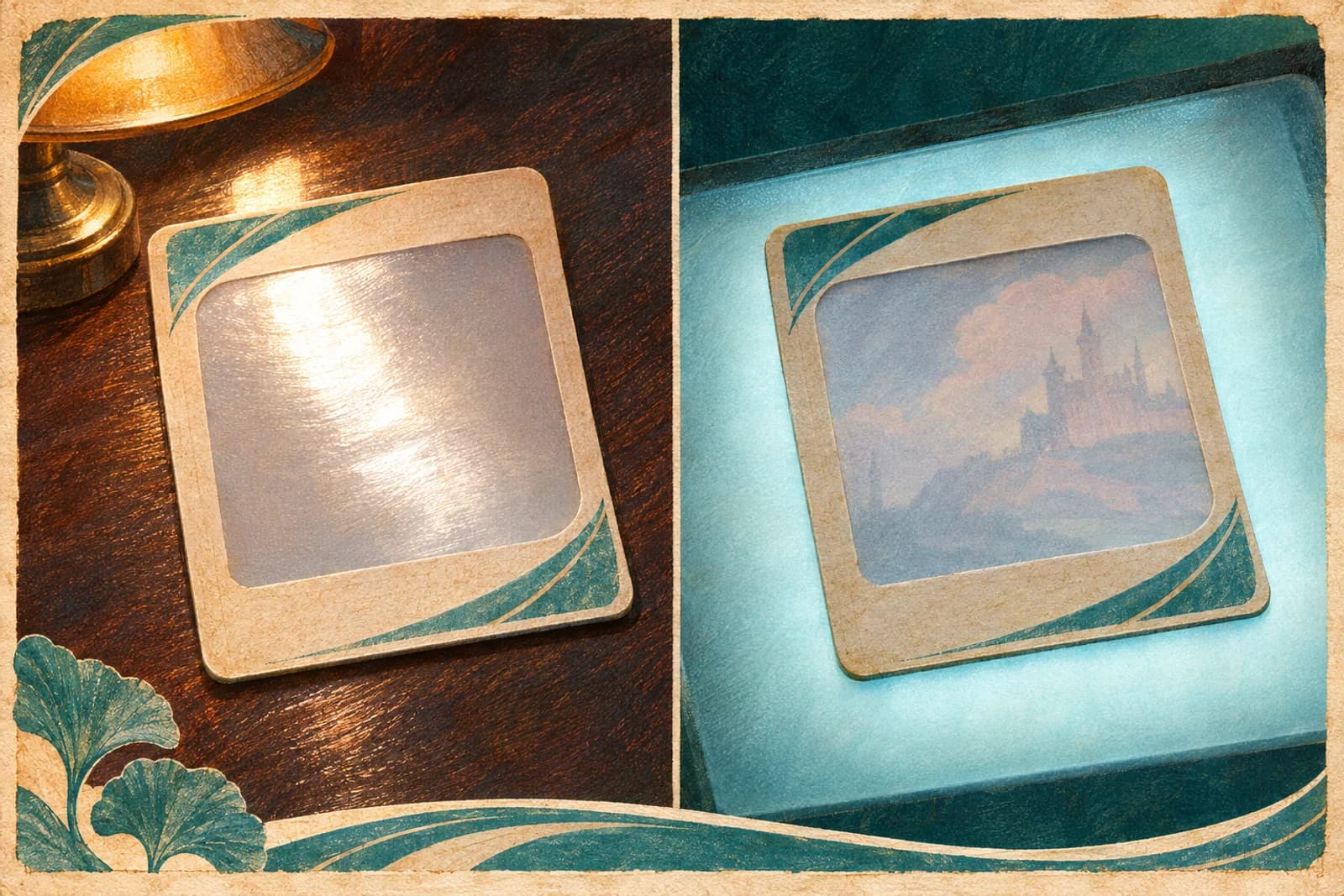
In the seller’s front photograph of 1950-1, a dark strip sits beside a monochrome portrait. The portrait is easy to read at a glance; the window is substantially darker than the surrounding artwork. Turn to the seller’s photograph of the reverse and the most useful details are in plain print: the code 1950-1, the identification of Elizabeth Olsen as Wanda Maximoff, and Upper Deck’s description of the insert as a manufactured film cel. The two photographs answer different questions. The front shows the design of the pictured copy and how the window appears under that lighting. The back gives a collector a way to identify the card without first having to decipher an image through the window.
Upper Deck’s standalone WandaVision checklist places 1950-1 in the 1950s group of One Lifetime or Another Film Cels. That match matters because the code identifies a specific checklist entry, while the portrait and the dark window are visual clues that could also describe other entries. The useful chain of evidence runs from the printed code on the pictured reverse to the manufacturer’s checklist, then back to the wording on the card for the nature of the insert. The checklist establishes where the entry belongs. The photograph records what the pictured example says. Neither provides a history of the material before it was put into the card.
The word to keep when describing the window is “manufactured.” A catalogue entry that drops it and says only “film from WandaVision” can suggest that the strip came out of a reel used in production or exhibition. The printed description does not support that reading. It also does not explain how the image was selected or how the insert was made. There is no need to write a competing account of its origin to avoid the overstatement. Record it as a manufactured film cel, attribute that description to Upper Deck, and leave any claim about a specific reel or screen use unverified. That is a limit on what the evidence establishes, not a finding about how every piece was produced.
Three details belong in separate fields: who is identified on the card, what the window contains, and what can be seen in the window. The printed identification supports Olsen as Wanda Maximoff for the first field. Upper Deck’s material description fills the second. The seller’s front photograph does not resolve enough of the dark window to fill the third with a confident frame identification. Even if another photograph showed Wanda clearly inside the window, that would be evidence about the image, not the history of the material carrying it. And if a viewer could match that image to an episode, the match would still not establish that the strip itself was used in making or showing the series.
Disney describes WandaVision as a combination of classic television and the Marvel Cinematic Universe, with Olsen as Wanda and Paul Bettany as Vision. That premise gives the monochrome portrait and the 1950s grouping a context: they echo the show’s use of older television styles. The distinction is between explaining why a design makes sense and documenting where a physical object came from. Disney’s description supports the first task. It does not identify the image in this particular window or tie the material to a production asset. A collector can appreciate the card as a reference to an era of television without treating that reference as a claim about an actual reel.
Consider a hypothetical collector choosing between a copy for a checklist binder and one for a display centered on the window. For the binder, a clear full reverse and a match to the manufacturer’s row may settle the identity question even if the front photograph leaves the insert hard to see. For the display, the same evidence leaves something important unresolved: whether the window is readable under the conditions in which the collector intends to show it. A clearer photograph of the window on the offered copy would help with that choice. It would not make the card a different checklist entry or supply missing provenance. If the seller cannot provide one, the collector can decide whether to accept uncertainty about appearance without accepting any uncertainty about what the card is called.
The photograph’s darkness is itself worth recording carefully. “Window appears dark in seller’s front photo” describes the evidence. “Window is blank” or “window is damaged” goes beyond it. The two listing views do not independently establish the card’s condition, and a pictured example is not evidence that every 1950-1 looks the same. A usable copy record would read: Upper Deck WandaVision; One Lifetime or Another Film Cels, 1950s; 1950-1; Elizabeth Olsen as Wanda Maximoff; manufactured film cel per card reverse. A separate note can say the window image was not confirmed from the available view. That lets the next person know exactly which part of the identification is settled and which part a better photograph might change.
WandaVision Is a Show Title and a Set Name
A search for “Upper Deck WandaVision 1” leaves out the field that decides which checklist to open: the product. Upper Deck uses WandaVision as the name of a standalone card release, and it also uses WandaVision to identify the screen property on entries in a different release, Marvel Studios Series 1. A seller can accurately include the word in a description of either card. The ambiguity arises when a search result or an inventory treats the word as the product name in both cases. A manufacturer name and a number do not solve the problem, because both checklists are Upper Deck’s and each has its own numbering.
Put the two base lists side by side. The standalone WandaVision checklist has a base No. 1, the first numbered slot in its 90-card base run. In the Marvel Studios Series 1 checklist, base No. 1 is listed as Elizabeth Olsen as Wanda Maximoff, with WandaVision identifying the screen property. The same separate release lists Paul Bettany as Vision at No. 2. The comparison is between slots in two products, not between competing descriptions of a single card. An Olsen result with the right number can therefore be a good match for someone collecting Marvel Studios Series 1 and still be the wrong purchase for someone filling No. 1 in the standalone base run.
A catalogue key should record five things: manufacturer, product, family, exact code, and variety. For the ordinary standalone No. 1, that reads Upper Deck, WandaVision, Base, 1, standard. The Marvel Studios Series 1 base entry shares the manufacturer, family, code and standard variety, but its product field makes it a different record. For the photographed cel, the product returns to WandaVision, the family becomes One Lifetime or Another Film Cels, and the full code is 1950-1. The “1” at the end is not its base card number. Upper Deck also uses the same base numbers on named parallel rows, so even a confirmed product and base number can leave the variety unresolved.
Keep subject and date information beside the key, not inside it. Marvel Studios Series 1 No. 1 and the photographed 1950-1 can both be indexed under Elizabeth Olsen and Wanda Maximoff without being filed as versions of each other. A collector who searches by performer needs those subject fields; a checklist collector needs the key. Dates have a similar division of labor. The photographed 1950-1 reverse bears a 2022 Upper Deck copyright, which supports entering 2022 in the field for copyright as printed on that example. It does not document the first retail sale. If the catalogue also has a field for a documented release date, leave it unverified unless supported by separate evidence of release.
Search aliases can be much looser than catalogue values. A seller might use “Wanda Vision” instead of “WandaVision,” type a code as “1950 1,” or describe the insert with the spelling “film cell.” A search index can retain those spellings so that a query still finds the record. The catalogue should retain Upper Deck’s product and family names and the exact code, including the hyphen in 1950-1. Search normalization should never promote a possible match to a confirmed one. In particular, it should not reduce 1950-1 to 1 because two listings use different punctuation, or expand a generic WandaVision title into the standalone product name when the release is not shown.
Suppose a collector has a blank space for standalone base No. 1 and finds a hypothetical listing titled “Upper Deck WandaVision #1 Elizabeth Olsen.” The title supplies useful search terms but does not settle which product is offered. The collector can ask for a full reverse and for confirmation of the release, then compare the card details with the two checklists. If the evidence points to Marvel Studios Series 1, the collector can keep it on a performer want list without marking the standalone slot filled. If the images and description still do not distinguish the products, the listing belongs in an unresolved queue. Spending time on that check is more useful than choosing the result with the neatest title or the most specific-looking date.
The same distinction helps when one buyer wants a single Olsen card and another wants a numbered run. The first can search expansively across both releases and choose on the strength of the pictured card. The second can use the same search to find candidates, but needs a product-and-family match before counting any of them. In a shared spreadsheet, a search term such as WandaVision can appear in both a product column and a screen-property column without one overwriting the other. That small separation preserves the thematic connection that made both cards interesting while keeping the checklist count tied to the object actually offered.
Three Different Ways to Call the Collection Complete
Before counting cards, decide which collection the number is meant to describe. Upper Deck’s standalone WandaVision checklist supports two straightforward finish lines: the 90 ordinary base cards, numbered 1 through 90, and the 36 unsigned One Lifetime or Another Film Cels, arranged in six decade groups of six. A third finish line is an expanded collection, but it needs a written list of included entries before it has a usable denominator. These are different projects, not different grades of completeness. A collector with all 90 ordinary base cards has finished that base run, even with no cel, plate or autograph in the binder.
For the base run, make one slot per ordinary number. A named parallel can be filed alongside the same number, but does not fill the ordinary slot under that rule. Imagine a collector who wants to arrange the show’s story in sequence and starts with the base run as a manageable acquisition goal. They can use 90 as the checklist denominator while keeping a second field for the narrative order they want in the binder. The published numbering establishes the checklist order, not necessarily the scene order the collector wants. If they own 72 verified ordinary base cards and several versions of the same numbers, the progress line is still 72 of 90, not a total of all the physical cards on those pages.
For the second finish line, use the 36 unsigned decade cels as the denominator. Upper Deck gives the signed and dual-autograph cels separate codes, so those cards do not substitute for a missing unsigned slot simply because they feature the same performer. A collector drawn to the show’s classic-television premise might instead plan a six-slot display, with one unsigned cel from each decade. Suppose that display is full and the collector also owns three more unsigned entries from decades already represented. The two honest counts are six of six display positions and nine of 36 checklist entries. The display no longer has a gap; the insert run still does. Neither count requires a plate or a dual autograph.
For an expanded project, write the rules as a list that could be handed to another collector. One hypothetical list includes all 90 ordinary base cards, all 36 unsigned decade cels, two specified Elizabeth Olsen single-autograph entries, FCA-EO and FCA-EO2, and the Olsen and Bettany dual-autograph entry FCDA-OB. That gives 129 slots, each defined before shopping begins. Under those rules, all other signed cels, named parallels, plates, sketches and rewards are excluded, not missing. Another collector might include all the signed cels or a choice of parallels, but should name those rows explicitly. “Base and anything special” is not a denominator someone else can reproduce, and it makes the target change whenever an unfamiliar listing appears.
Different formats also require different rules for what counts as one slot. For same-number parallels, specify whether the goal includes an exact named variety or merely one example from a declared group of alternatives. For plates, decide whether an example associated with a particular card is enough or whether the goal requires separately documented pieces. For sketches, decide whether one verified sketch satisfies the collection, whether there is one slot per selected artist, or whether particular copies are being tracked. A checklist entry does not by itself define an inventory of every individual object. Write the unit next to the entry so that one sketch, one plate or one parallel cannot silently become several completed slots.
Give rewards their own inclusion rule as well. Upper Deck’s e-Pack terms distinguish digital items with a physical counterpart from other digital items, and say that achievements can become unavailable after a deadline or when inventory runs out. A physical collector can exclude rewards entirely, or name a documented reward and require a verified physical copy for the slot. An unresolved account entry is not a delivered card, and an old reference to an achievement is not evidence that it can still be claimed. If the reward is already a documented part of the scope, uncertainty about obtaining it does not make it disappear from the denominator. If its identity has not been established at all, keep it in a research queue rather than inventing a slot.
Finally, distinguish the status of a slot from the count of cards in hand. In the hypothetical 129-slot list, 100 might be verified and in hand, 28 might be verified targets with no copy owned, and one might have a candidate copy whose exact code is still unverified. The result is 100 of 129, with the pending copy visible rather than credited or silently treated as absent. Items ruled out by scope sit outside that denominator. This makes the next decision concrete: the story collector can look for a confirmed ordinary base card, while the era collector can improve a display copy without changing the display count. Both can decline an attractive plate without treating that choice as a failure to finish.
Why a Yellow No. 1 Is Not a Duplicate
The ordinary No. 1 and the Mind Stone Yellow No. 1 belong together in a binder, but they do not fill the same checklist slot. Upper Deck repeats the base numbers on named parallel rows in its standalone WandaVision checklist. The number tells you which base entry the parallel corresponds to; the variety tells you which version you have. If your goal is one ordinary copy of every base card, a Yellow No. 1 does not fill a vacant ordinary No. 1 slot. If your goal is every listed version of No. 1, owning the ordinary card does not make the Yellow a spare. In that collection, a duplicate would be a second copy of a version you already have.
Upper Deck lists Mind Stone Yellow at one per blaster pack. It lists Purple Spell and Scarlet Red each at 1:2 in hobby, e-Pack and blaster. Read those figures alongside the variety and sales channel to which they apply. One Yellow per blaster pack is not one Yellow No. 1 per pack. Likewise, 1:2 is a published rate for each named parallel, not a rate for Purple Spell No. 1 or Scarlet Red No. 1. The matching Purple and Red rates do not tell you whether the two versions appear together, alternate or follow any other sequence. The checklist gives collectors a way to compare the published frequency of the varieties without establishing how individual numbers are distributed.
Green Vision, White Vision and Black and White use a different kind of number: Upper Deck lists serial denominations of 225, 99 and 25, respectively. If a hypothetical Green Vision No. 1 shows a stamp of 037/225, then 1 is the base number, 037 is the serial numerator on that copy and 225 is the denomination for that parallel. The 037 does not turn it into base No. 37, and the stamp does not establish when the card was made or packed. Nor does /225 mean one per 225 packs. A serial denomination describes the numbering of an edition; a pack rate describes a stated frequency in a particular channel. Neither tells you how many copies are currently available to buy.
A usable inventory has two levels. Start with a parent record for Upper Deck WandaVision, Base, No. 1. Under that parent, create separate variety records for Standard, Mind Stone Yellow, Purple Spell, Scarlet Red and the numbered parallels you intend to track. Keep the official variety name rather than shortening it to a color that could describe some other card. Within the variety record, keep the listed denomination separate from the stamp observed on an individual copy. Two Green Vision No. 1 cards with different numerators occupy the same variety slot, but they are different physical copies. A collector tracking both can record each stamp and its supporting photograph without inflating the number of varieties owned.
Suppose a seller describes a No. 1 as Mind Stone Yellow, but a warm desk lamp gives the whole front photograph a yellow cast. Another collector thinks they see the green of Green Vision. Neither interpretation establishes the variety from that image. Ask for a straight-on front in neutral light, a full reverse showing the product and number, and a close-up of any serial stamp. Ask whether all the photos show the exact copy for sale. The reverse may settle the product and base number without settling the parallel. A legible /225 stamp on a copy otherwise consistent with Green Vision would support that identification and conflict with the Yellow title. A cropped photo in which no stamp can be seen is not evidence that the card has none.
The photographed 1950-1 Film Cel offers a useful comparison even though it is not a base parallel. Its reverse supplies a legible code and a description of the insert; the unusually dark appearance of the window in the front view supplies neither. A parallel listing presents the same division of work between photos. The back may establish which card number is being offered, while the front and any stamp may be needed to establish the variety. Ask for the view that would resolve the particular disagreement rather than another copy of the same promotional image. If the new photographs verify No. 1 but leave the color and stamp unclear, record the candidate as No. 1 with its variety unverified.
That unresolved status matters most when the variety is the reason for buying. A hypothetical collector filling the Mind Stone Yellow slot gains little from a listing that confirms only the number; passing on it leaves a known gap rather than adding a questionable entry. A collector who simply wants a visually appealing No. 1 might accept the same uncertainty after seeing the offered copy, but should not count it as a verified Yellow. In both cases, keep the maker’s variety and published figures in the checklist record, the seller’s description in the listing notes, and the observed color and stamp in the copy record. A correction to the listing then does not rewrite the checklist or erase what was actually visible.
Film Cel, Plexi, Acetate or Plate?
A card can let light through without telling you what kind of insert it is. The photographed Film Cel has an image-bearing window; Plexi and Acetate also appear in Upper Deck’s checklist for other insert families. Transparent areas, a glossy finish or a bright reflection are useful things to describe in a photograph, but none is a substitute for identifying the checklist row. Start with the subgroup name and exact code, then check whether Upper Deck filled in the technology field. Keep the checklist wording separate from what you can observe on the offered copy. The checklist is not a material test or a measurement of the card’s thickness.
Film Cel | One Lifetime or Another Film Cels | 1950-1. Here the number is a checklist code, not an individual serial stamp. Upper Deck puts it in the 1950s Film Cel group, and the photographed reverse calls the window insert a manufactured film cel. Record that wording as the manufacturer’s description rather than using the darkness or transparency of the window to infer its composition. The portrait and code can be clear while the window image remains hard to read. That is a reason to ask for a better view of the insert, not a reason to enter the card as a different technology or mark the window as empty.
Plexi | Wanda’s Reality Plexi | P-17. Upper Deck lists P-17 in Wanda’s Reality Plexi and separately records Plexi in the Mem/Tech field. It also lists Wanda’s Reality Autographed Plexi and Wanda’s Reality Dual Plexi as separate families, so “Wanda’s Reality” alone does not identify the subgroup. Record the full family name and use the code on the offered copy to select the row. If a listing supplies only a front photo and the phrase “Wanda Plexi,” leave the exact entry unverified rather than borrowing a code from an image of another copy.
We Interrupt this Program Acetate | WE-9. Upper Deck includes “Acetate” in the checklist family name, but leaves the separate Mem/Tech field blank for WE-9. Record the full family name as listed without treating it as independent confirmation of the card’s construction. A listing photograph can help document reflections or visible marks, but apparent thickness or transparency can vary with angle, background and lighting. Keep We Interrupt this Program Acetate and Wanda’s Reality Plexi as separate checklist families rather than filing both under “clear cards.”
Ordinary insert | Welcome to Westview | PR-1. Plate | Welcome to Westview plate counterpart | PR-1. This is a case where an exact code gets you to two candidates rather than one. If a seller includes PR-1 and Welcome to Westview in the title, those terms can be consistent with either row. The ordinary insert and the plate need separate records, with the format or checklist family included in the key. A plate is not a second ordinary PR-1 simply because it shares the code. Conversely, unusual color or a strong reflection in a photograph of PR-1 is not enough to assign the card to the plate entry.
For a plate record, enter four as the listed denomination for the PR-1 plate entry and keep separate fields for observed color and individual marking. If neither detail is legible, enter “not verified” for both. The checklist’s denomination does not identify the piece in a particular seller’s hands, and it does not justify copying a stamp or a color from a different example. Suppose a hypothetical listing calls a PR-1 a plate and shows a tight crop of the artwork but no readable back or markings. The plate row makes the seller’s description possible. It does not resolve whether that listing shows the plate instead of the ordinary insert. A plate buyer has a concrete reason to wait for more evidence.
Tailor the photo request to the unresolved feature. For 1950-1, ask for a full reverse and a separate view with gentle, diffused light behind the window so its image can be evaluated without losing the rest of the card in glare. For a Wanda’s Reality Plexi card, ask for the full reverse and an angled view of the face to show how reflections move across the surface. For WE-9 or another acetate entry, ask for a full reverse and a face view against a plain background, plus an angled view if a line or blemish is at issue. For ordinary PR-1, request uncropped front and back views; for the plate counterpart, request those views and close-ups of any plate markings. If a requested detail is absent or unreadable, record that limitation rather than letting the shared code or the look of the surface stand in for it.
Six Decades, Six Cards Each, but Not Six Identical Lineups
Upper Deck organizes the unsigned One Lifetime or Another Film Cels into six blocks, starting with the 1950s and ending with the 2000s. Each block contains six codes. The first part of a code identifies the decade group, and the suffix identifies a slot within that group. Nothing about the numbering makes the first slot in each decade the same performer or character. Six cards per decade gives you a grid of equal size, not six repeated cast lists. Before laying out a binder page by performer, check the subject descriptions across the rows rather than assuming the suffixes give you a cast order.
For a six-slot display, label the positions 1950s, 1960s, 1970s, 1980s, 1990s and 2000s. Put one verified unsigned cel from the corresponding group in each position. A collector could start with 1950-1 in the first position because they want Olsen’s Wanda Maximoff as the opening portrait, then choose the other five after seeing the available copies. There is no requirement to choose a code ending in -1 every time. If the point is to evoke a succession of television styles, the collector might choose the card that reads most clearly in each position. If the point is to follow a performer, they may prefer a relevant subject elsewhere in the same group, when one is listed.
For the full six-by-six checklist, give each decade its own row and each exact code its own cell. The 1950s row is 1950-1, 1950-2, 1950-3, 1950-4, 1950-5, 1950-6. The 1960s row is 1960-1, 1960-2, 1960-3, 1960-4, 1960-5, 1960-6. The 1970s row is 1970-1, 1970-2, 1970-3, 1970-4, 1970-5, 1970-6. The 1980s row is 1980-1, 1980-2, 1980-3, 1980-4, 1980-5, 1980-6. The 1990s row is 1990-1, 1990-2, 1990-3, 1990-4, 1990-5, 1990-6. The 2000s row is 2000-1, 2000-2, 2000-3, 2000-4, 2000-5, 2000-6. Use the grid as an index even if the physical pages are arranged by character. That way changing the display order does not obscure which code belongs in each decade.
Paul Bettany and Elizabeth Olsen are useful performer filters, not shortcuts to individual codes. Disney identifies them as Vision and Wanda Maximoff, respectively, and Upper Deck’s unsigned cel checklist gives a collector multiple rows to consider when searching by performer. An Olsen filter can surface 1950-1, but Olsen’s name does not make a different decade entry an alternate copy of 1950-1. A Bettany filter likewise narrows the checklist to entries of interest without distinguishing one selected card from the next. Keep a performer field for searching, a manufacturer subject field for the wording on the row, and the full code for identification. That lets a collector pull selected cards into a cast display and still put each one back in its correct grid position.
Teyonah Parris’s cards show why the performer and manufacturer subject fields should stay separate. Upper Deck lists her as Geraldine on 1960-4 and as Monica Rambeau on 1970-4. A performer search can return both cards without implying that Upper Deck used the same description for them. Leave Geraldine in the manufacturer subject field for 1960-4 and Monica Rambeau in that field for 1970-4. If a seller uses a different character name for 1960-4, compare the exact code on the offered card with the checklist rather than using the listing title to choose a slot.
Treat the decade as the insert’s theme, not a date assigned to the image or the material. Disney’s description of the series explains why television eras make sense as a way to arrange the cards, but it does not identify the image in a given window. A collector might recognize a costume or a room and have a plausible episode candidate. Put the candidate in an observation note until a sufficiently clear image and an independent reference support the match. Even a confirmed scene identification would be a separate field from the decade group. A 1960s checklist slot stays in the 1960s row regardless of whether the collector can name what is visible in the window.
In practice, the two layouts can lead to different decisions about the same offered card. Suppose a six-slot display already has a 1960s cel with an easily readable window, and the collector is offered a confirmed 1960-4 whose window is hard to see in the listing. There is no decade gap for the card to fill, so the collector can wait for a view that shows whether it would improve the display. If 1960-4 is an empty cell in the full grid, the verified code makes it relevant even if the window view remains inconclusive. If the collector also indexes cards by performer, the card can appear under Teyonah Parris without creating another physical copy or changing the Geraldine description recorded from Upper Deck’s row.
What the Pack Odds Can and Cannot Tell You
Upper Deck’s odds for the unsigned One Lifetime or Another Film Cels answer a narrower question than a collector’s want list does. They give a published pack rate for a decade group in a particular channel. A collector missing any 1990s cel can use the 1990s rate as a reference. A collector missing only 1990-4 needs a figure the checklist does not provide: the rate for that exact code. The distinction matters because Upper Deck repeats the group odds on individual rows. Where six rows carry the same figure, the repetition does not establish six separate chances at that rate. Read the numbers across channels for the same group before trying to apply them to a particular card.
Unsigned Film Cel group rates published by Upper Deck
Decade group Hobby e-Pack Blaster
1950s-1980s* 1:60 1:60 1:180
1990s 1:90 1:90 1:270
2000s 1:180 1:180 1:360
*The 1950s, 1960s, 1970s and 1980s are four separate groups with the same listed rates, not one combined group.
The table shows that a 2000s cel has a lower published group rate than a 1950s cel within each channel. It also shows that the channel difference is not a uniform multiplier. For each of the first five decades, the blaster denominator is three times the hobby or e-Pack denominator; for the 2000s, it is twice as large. That comparison describes the published rates, not the relative number of cards made or the number that reached collectors. Identical hobby and e-Pack figures do not establish equal quantities in those channels, either. You would need information about pack volumes and allocation to attempt a production comparison, and the public checklist is not a production audit.
To turn 1:60 into a rate for one of the six codes, you would have to assume that each code accounts for exactly one sixth of the group hits in that channel. Under that assumption, and treating a group hit as returning one code, the chance for 1950-1 would be one sixth of 1 in 60, or 1 in 360 per hobby pack. That calculation is a hypothetical, not a figure Upper Deck lists for 1950-1. Six distinct codes establish six possible results, not six equally frequent results. If one code accounted for more of the group hits than another, both collectors could open packs with the same published group rate while facing different chances of finding their respective targets.
A box calculation adds another assumption. Suppose someone considers opening 24 hobby packs, purely as an example, and asks about finding at least one 1950s cel. If every pack had a 1-in-60 chance of containing one and the packs were independent, the chance of missing in all 24 would be (59/60) raised to the 24th power. Subtract that result from one and the chance of at least one hit is about 33 percent. Apply the same assumptions to 60 packs and the result is about 64 percent, not certainty. Neither number is a box forecast. The checklist does not tell you whether insert placement in sealed product follows an independent model, and the example does not describe an actual box configuration.
Independence and equal representation answer different questions. Independence is about whether one pack’s result changes what you should expect from another pack in the group you are opening. Equal representation is about which code appears when a pack yields a cel from that decade. You could have equally represented codes but nonindependent placement across packs, or independent pack results with one code appearing less often than another. Even a tally of group hits from a few openings would not settle both questions. For an inventory, keep the channel and published group rate together and leave the exact-code odds unverified. That preserves a useful comparison without turning assumptions into new checklist data.
The practical decision depends on how many outcomes would count as a success. Suppose a collector building an era display would welcome any of several cels and also wants to see what else comes out of the packs. Opening sealed product serves that broader goal even if the preferred decade never appears. For a collector whose only vacancy is 1950-1, even five other 1950s codes would leave the vacancy open. A single offered with a legible reverse can be checked against that exact slot before purchase. As the photographed 1950-1 example shows, a code can be clear even when the window is dark in the front view, so identifying a single does not settle whether it suits a display. Buying a confirmed single replaces the uncertainty about which code turns up with a decision about the particular copy on offer. It does not guarantee a satisfactory window, condition or price.
How to Check a Listing When Its Fields Disagree
The eBay listing for 1950-1 makes a useful distinction between identifying the card and accepting every attribute shown on the sales page. The title gives the WandaVision name, the 1950-1 code and the Film Cels description. The gallery shows the Upper Deck branding, and the reverse confirms the code and names Elizabeth Olsen as Wanda Maximoff. Those details match the unsigned One Lifetime or Another Film Cels entry in Upper Deck’s standalone WandaVision checklist. Yet the listing also displays structured autograph-authentication information. That field is part of the marketplace record, not a certification shown on the pictured card or established by the checklist. It does not show that Olsen signed the offered card or that anyone authenticated a signature on it.
Begin by working out whether the conflicting fields are even describing the same product. A search result can put cards from the standalone release next to cards from Upper Deck’s Marvel Studios Series 1, which also contains Olsen as Wanda. If the listing title relies on the show and performer names, set those terms aside and locate the code and other identifying details on the card itself. In the 1950-1 example, the full code on the reverse and the standalone checklist’s corresponding insert row do the work. A title or item-specific field that points to a different product requires an explanation, even if both products feature the same character. Do not resolve it by assuming that the product more prominently named in the listing is the one the seller will ship.
Next, establish which object the photographs describe. A full reverse is useful only if it belongs to the copy being offered. Ask whether the front, back and any close-ups all show that copy, especially when a listing offers multiple examples or combines a stock image with a new photograph. If the seller confirms the photos and the code is legible, compare it with the manufacturer’s row before weighing any optional claims. If an updated reverse shows a different code, restart the identification. If the seller cannot confirm which copy is pictured, keep two separate notes: the identity of the card shown and the identity of the card promised. The first can be clear while the second remains open.
Then ask what kind of evidence supports the disputed attribute. The reverse of the listed 1950-1 describes a manufactured film cel. That is evidence of what Upper Deck says about the insert, not support for a seller’s inference about where the strip came from. The autograph field has a different problem: it suggests an attribute that the unsigned manufacturer row does not supply. It is possible in principle for someone to sign an unsigned card later, so the checklist alone cannot rule out every mark on every copy. It does rule out reading that row as a manufacturer-issued autograph. If a seller affirmatively claims a later signature, ask where it appears, request a clear image of it, and ask for the documentation behind any authentication claim. A field label is not a substitute for either.
Decide whether new photographs could resolve the uncertainty before asking for more of them. On the photographed 1950-1, the available reverse is useful for identity, but the dark front window gives limited evidence about how the image reads. An oblique view can help show whether a line moves with a reflection, and a separate view with diffused light behind the window can make the insert easier to inspect. An uncropped front and back can show whether a corner omitted by a close crop is visibly worn. None of those views establishes a grade, and if the relevant surface is hidden by glare or a sleeve, the right conclusion may be that the particular condition question cannot be answered remotely. That is different from finding a defect.
Before committing, save a dated image of any material claim and the photographs used to assess it. Include the listing title, the item-specific field in dispute, any clarification from the seller and the view showing the code. Keep the seller’s wording separate from the catalogue identification. In this case, a useful note would distinguish the pictured 1950-1, which matches the unsigned checklist entry, from the autograph-authentication metadata, which supplies no supporting evidence for a signature. Saving the two together lets you reconstruct why you treated the field as unsupported even if the seller later edits it. The saved material records the representation and your basis for identifying the pictured example; it does not independently verify custody or condition.
Consider two hypothetical responses to a query about the autograph field. One seller confirms that the pictured 1950-1 is the exact copy and that no signature is being offered. A buyer looking for the unsigned card can proceed to the condition question without treating the original field as part of the sale. Another seller insists the card is a factory autograph but supplies only the same unsigned code and no image supporting the claim. A buyer seeking a factory signature should pause rather than guessing which signed version the seller meant. If the remaining disagreement is instead about a faint mark outside the window, the identity may be settled while the condition decision is not. Treating those as separate decisions makes it possible to decline an uncertain copy without misclassifying a known checklist entry.
FCA-EO and FCA-EO2 Are Two Checklist Entries
A want list that says only “Elizabeth Olsen autograph Film Cel” can describe a perfectly clear collecting goal, but it cannot distinguish the two Olsen single-autograph cel entries in Upper Deck’s standalone WandaVision checklist. FCA-EO and FCA-EO2 list the same performer and character, Elizabeth Olsen as Wanda Maximoff, but the second code is not an optional spelling of the first. The suffix is part of the identifier. A collector who wants either card can treat the two codes as alternatives. A collector tracking both has two slots, and a second copy confirmed as FCA-EO does not fill the FCA-EO2 slot. There is no need to infer a chronology from the suffix or decide that one entry supersedes the other to record them correctly.
Picturesque Signatures is a separate family in the same product. It is therefore possible for a seller’s generic description of a Wanda autograph to be relevant to a signer search while saying too little for a Film Cel purchase. A seller need not put the entire checklist family in a short title, but the buyer still needs to match the pictured card to the appropriate family and code. Ask for an uncropped front and a reverse where the code can be read, not just a close-up of the signature. That close-up can help you compare the visible mark on different offered copies. It cannot tell you whether the card belongs under Picturesque Signatures or one of the two FCA entries.
Upper Deck publishes two different levels of odds for the single-autograph cels. The overall rate for the family is 1:240 in hobby and e-Pack. That figure is not the odds for an Olsen signature. The checklist also lists 1:5,587 for Group B, repeating that figure on both Olsen rows. Group B is the narrower category to which those rows belong, not a separate 1:5,587 chance for FCA-EO plus another 1:5,587 chance for FCA-EO2. Adding the repeated figures as if they describe two independent opportunities misreads the table. Conversely, dividing the group rate in half to produce a rate for one Olsen code would require information about the group’s composition and the relative distribution of its entries that the repeated figures do not provide.
That distinction matters when choosing between a signer goal and a checklist goal. Imagine a collector who wants one Olsen autograph for a Wanda display and is open to either FCA code or a card from Picturesque Signatures. The collector can compare confirmed singles across those families without treating the Film Cel family rate as a measure of how likely an arbitrary pack is to satisfy that broader goal. Now imagine a collector who already owns FCA-EO and is looking only for FCA-EO2. An Olsen name match, a Group B match and a close-up showing a signature all leave a decisive question unanswered if the suffix is cropped out. The useful next step is to request the missing view, not to rank the options by a published figure that is identical on both rows.
A signer inventory can make that purchase decision easier by separating the checklist entry from the evidence about the copy. Give the product and family their own fields: Upper Deck WandaVision and the single-autograph Film Cel family. Enter FCA-EO and FCA-EO2 as separate exact codes, with Elizabeth Olsen as the listed signer and Wanda Maximoff in the character or role field. Keep an observed-signature field distinct from the listed-signer field. One records what can be seen in a photograph of the offered copy; the other records the manufacturer’s intended configuration. If you record odds, put 1:240 beside the family and 1:5,587 beside Group B. Neither belongs in an exact-code odds field.
Add a separate field for how the signature was applied, and leave it unverified when the card and the available documentation do not establish the method. A manufacturer checklist can identify the signer without answering whether the signature was applied directly to the card or on a label. A front photograph can document the appearance of a mark and still leave its construction unclear under glare or at low resolution. CGC Cards’ autograph guidance distinguishes manufacturer-certified pack autographs from signatures handled under other authentication or witnessing routes. That distinction is about the status of the signature, not a promise that a catalogue row, seller adjective or generic description establishes the application method. If that detail affects which copy you want, ask for evidence aimed at that question rather than accepting a bare “on-card” claim.
Suppose a hypothetical listing is titled FCA-EO2 but the offered copy’s legible reverse says FCA-EO. If the seller confirms the photographs are of the copy that will ship, the inventory match is FCA-EO; the title does not supply the missing suffix. If the seller says the photographs show a different copy, neither code should be credited to the offer until the seller supplies an image of the actual card. A collector who accepts either code may have more room to consider an otherwise suitable copy, but still has a reason to record the exact entry after verification. The code determines the slot, the listed signer explains why it belongs on the want list, and the photographs determine which claims about the offered copy can be checked.
Two Faces on a Card Do Not Mean Two Signatures
DP-9 and FCDA-OB both pair Elizabeth Olsen and Paul Bettany, but they belong on different want lists. Upper Deck identifies DP-9 as an unsigned Dual Plexi. The pairing describes the two people depicted, not two people who signed it. FCDA-OB is a dual-autograph Film Cel for the same actors, and Upper Deck lists it with a serial denomination of 15. On that row, the names describe the intended signers, not merely the subjects. A collector looking for a card that depicts both leads might be satisfied with DP-9. A collector looking specifically for both signatures on a manufacturer-issued Film Cel needs the FCDA-OB entry. A seller title such as “Olsen Bettany dual” leaves the distinction open.
Upper Deck lists six FCDA rows. Treat them as six distinct entries if the goal is the complete dual-autograph Film Cel checklist. DP-9 fills none of those slots, and a second FCDA-OB with a different serial numerator remains a second copy of one entry. A collector who wants only Olsen and Bettany can instead give the project a denominator of one: the specified pairing on the specified Film Cel. That narrower goal does not require the collector to pursue the other five rows. It also makes a candidate easier to evaluate. A listing for another FCDA code may belong to the right family, but it does not satisfy a goal defined by FCDA-OB.
The 15 beside FCDA-OB is a serial denomination, not a pack rate. If an offered copy shows a legible stamp of 08/15, the 08 identifies its stated sequence number within that denomination. It does not tell you where the card was packed or how often that pairing appeared in any sales channel. Estimating a pull rate would require information about how many copies went into a defined pool of packs and how many packs were in that pool. The denomination does not supply either figure. Nor does the existence of six checklist rows establish that the pairings were distributed equally. Leave the exact pairing’s pack rate unverified rather than interpreting /15 as one hit in 15 packs.
In a copy record, give pictured participants, manufacturer-listed signers and visible signature marks separate fields. For DP-9, Olsen and Bettany go in the first field, and the checklist supplies no manufacturer-issued signers. For FCDA-OB, both names belong in the listed-signer field. Fill the pictured-participant field from the artwork, and describe the marks from photographs of that copy. A useful observation is “one mark legible; second signature area obscured by reflection.” That is more precise than “one autograph,” which might be read as a conclusion that the other mark is absent. If you cannot confidently associate a visible mark with one of the two signers, record what is visible without guessing whose it is.
Suppose a hypothetical seller shows a reverse with FCDA-OB and a tight front crop in which one signature is clear. The seller says the second is there, but the area where it should appear is lost in glare. The checklist establishes that this code was issued as a dual autograph. It cannot tell whether the second mark on the offered copy is clear, faded, obstructed by a holder or simply outside the crop. The first close-up does not resolve the second signature by association. Ask for new images of the same card, then keep the checklist match and the unresolved condition question separate. If the seller cannot show both marks and their appearance is why you want the card, there is a concrete reason to wait.
Request three kinds of views. First, ask for an uncropped front that shows both signature areas in relation to the artwork and cel window. Second, ask for the full reverse with the exact code in focus, plus a readable view of the serial stamp wherever it appears. Third, ask for a close-up of each signature under even light, with a second angle if reflection obscures either mark. Confirm that all the images show the same copy. A full-card view lets you place each close-up, while the close-ups let you assess whether parts of a mark disappear at the edge of a label, under glare or in the image crop. Record only what the resulting views let you distinguish.
Good photographs can document the appearance of the marks without settling that copy’s authenticity. CGC Cards distinguishes most manufacturer-certified pack autographs, which can generally go through regular certification subject to its exceptions, from signatures authenticated separately or witnessed under a qualifying program. Its published guarantee excludes the authenticity of manufacturer-certified pack-pulled autographs and excludes autograph grades. If a hypothetical seller calls a slabbed FCDA-OB “independently authenticated twice,” ask what the label and related documentation actually say instead of inferring a service from the holder or the two names. A buyer seeking an Upper Deck-issued dual can evaluate it against that description. A buyer requiring a particular independent finding needs evidence of that finding, not just a matching code and two visible marks.
Sketches and Errors Need Different Evidence
Upper Deck repeats SKT across artist rows in the WandaVision checklist. That makes the code useful for finding the sketch family, but not for choosing the artist row or identifying the individual piece. An inventory that files every sketch under SKT alone will collapse records that a collector may need to keep apart. Start with the product and family, retain SKT as printed or listed, and add the artist credited on the offered card when the attribution is legible. Match that credit to the checklist rather than choosing an artist from the style of the drawing. If neither side of the card supplies readable evidence of the credit, keep the artist field unresolved. The shared code does not break the tie.
A sketch record needs a description of the subject as observed, separate from the artist credit. A seller might call the figure Wanda Maximoff while the front photograph shows only a cropped face. The seller’s identification can go in the listing notes; the observation field can say that the figure is not identifiable from the available view. Ask for the complete front to document the drawing and the full back to document the product and any credit or notation. Do not carry a character designation from one SKT copy to another just because the checklist puts both under the same artist. The artist row and the drawing in front of you answer different questions.
Assign each physical sketch a local copy ID tied to its front and back images. That ID is an inventory tool, not a manufacturer serial number or a claim about how many sketches an artist made. Imagine a collector who has a sketch filed under one artist and finds another listing with the same artist and code. An uncropped front and back could show a different drawing, in which case the collector has evidence for a second copy record even though the pair shares a checklist row. If instead the seller uses a stock photo and cannot show the specific card, the collector can log an offer without creating a verified copy. The artist slot may already be full even if the new sketch would bring a different drawing to the collection.
WE-9 presents a different recordkeeping problem. In the We Interrupt this Program acetate family, Upper Deck marks the WE-9 row UER. Preserve that notation on the checklist record as the manufacturer’s notation. It is evidence that the maker flags an error on the row, not evidence that there is a separate corrected printing. It also does not classify every oddity visible on an offered WE-9 as part of the listed error. For a collector who wants the manufacturer-listed acetate run, keep WE-9 as one slot unless evidence supports another. A seller calling a copy “corrected” has made a separate claim that needs support beyond the listing title or the fact that the checklist carries the UER notation.
Keep four explanations available when something seems wrong. An error flagged by Upper Deck belongs in the checklist notes. A typo that appears only in a listing title belongs in the listing notes; it does not change the card. A transparent area or printed element may be part of the intended design, in which case it should not be logged as an error without contrary evidence. Physical damage is a condition question about the individual copy. CGC Cards includes surface and edges among its grading criteria, but those criteria do not identify the origin of a line seen in one photograph. For instance, a bright streak over a clear area might come from the lighting, a sleeve or the card itself. The checklist flag does not tell you which.
Consider a hypothetical WE-9 listing that advertises a corrected copy and circles a spot where a line appears to be missing. The photographed card is in a glossy sleeve, and the reverse is shown at a different scale. Ask the seller to specify what is supposedly corrected and to show that feature in a full view and in close-up under more than one angle. The reverse can confirm the code; comparison with a clearly documented example can help establish whether any actual difference is visible. Even if two copies look different in comparable images, that alone does not establish whether the difference was deliberate, arose during manufacture or occurred later. It certainly does not establish how many copies share it.
An unresolved record should say what conflicts and what would resolve it. For the hypothetical WE-9, write: “Code confirmed; Upper Deck notation UER; seller claims corrected copy; claimed difference not verifiable from supplied photographs.” A clearer picture can change the observation field without creating a new checklist entry. For a sketch, write: “SKT visible; seller attributes artist; credit not legible; individual drawing shown only in crop.” That sketch can remain a candidate until the seller provides full views of the offered copy. The two records hold different uncertainties: one concerns whether a claimed variant exists, and the other concerns who made a particular piece and what it depicts. Neither uncertainty belongs in a print-run field.
An e-Pack Account Entry Is Not Always a Shippable Card
A WandaVision entry in an Upper Deck e-Pack account confirms that something is recorded there, but it does not establish that a card can be mailed. Upper Deck’s terms distinguish digital items that have a physical counterpart from digital items that do not. For a physical collection, track four states separately: digital only, eligible physical item in the account, physical item transferred to a fulfillment partner, and physical card delivered. A card may reach the final state through an available shipping route without going through a partner transfer, so this is an inventory model, not a mandatory sequence. Its purpose is to distinguish an item you can see on a screen from one you can check against the binder in front of you.
Use the digital-only state when the platform identifies the entry as having no physical counterpart. Save the item name, the exact code or variety shown, and the dated account view supporting that classification. If a screenshot shows the card art but cuts off the eligibility details, mark physical status unverified instead of assuming the item is digital only. A digital entry can count toward a collection whose rules allow digital holdings. It does not belong in the physical-in-hand column, even if the artwork and numbering match an entry the collector is looking for. COMC’s instructions make the fulfillment consequence concrete: a digital-only card cannot be transferred as a physical card to a linked COMC account.
Use the second state when the signed-in inventory identifies the exact item as physical or as linked to an eligible physical counterpart. Upper Deck’s general collecting guide explains how the platform indicates physical items. Save the identifier and the eligibility indicator together, rather than saving a product image and assuming the designation applies across the set. This state tells you more than the first, but it still does not document a transfer, a shipment or a delivery. If the collector intends to use a particular fulfillment partner, check which options the account actually offers for that item. A general platform guide and a public checklist cannot answer an account-specific question about a particular copy.
Combining digital duplicates is a different action from transferring an existing physical item. Upper Deck describes eligible combinations that produce a physical parallel, and COMC says digital duplicates have to be combined first where an eligible physical result exists. The thing a collector transfers in that case is the resulting physical item, not the digital entries that went into it. Before treating a combination as a way to fill a physical WandaVision slot, verify the exact required inputs and the named result in the account. A physical parallel may not fill a slot reserved for the ordinary version, even when the two share a number. The platform-wide example supplies neither a WandaVision duplicate threshold nor proof that the option is available on a particular account.
For the third state, record the exact card, the named fulfillment partner and the dated status in Transfer History. Upper Deck directs signed-in users there for shipment and transfer details. Its general shipping page names both COMC and The Authority, while COMC’s instructions describe only the route to a linked COMC account. Use the partner shown in the actual transaction rather than assuming every physical item follows the same route. If the history shows only a request or a pending transfer, keep the pending status instead of logging it as completed. When the transfer is complete, a matching entry in the receiving account can help distinguish a card held by the partner from one that is still recorded only on e-Pack.
Use the delivered state when the collector has received and checked the physical card. Keep the receipt or packing record and confirm the code and variety on the card against the inventory entry. A shipment notice documents movement, not the contents of an unopened parcel. If a parcel arrives and the card inside has the right number but the wrong parallel, record the delivered copy as the variety actually received and leave the intended slot unresolved. If a physical card is still with a fulfillment partner, it can be counted under a separately defined off-site holdings total. Calling it in hand would hide the difference between control of an account entry and possession of the object.
Suppose a collector has 89 of the 90 ordinary WandaVision base cards in a binder and sees the missing number in an e-Pack account. The number alone does not settle either the variety or the physical status. A digital-only entry can count toward a separate digital checklist, and a physical parallel can count toward a parallel run, but neither fills the ordinary slot in the binder. If the account does not confirm a fulfillable physical copy of the exact variety, keep that slot open. For an item the account does identify as eligible for fulfillment, a completed transfer changes where it is held; the physical-in-hand count changes only after the collector receives and checks the card.

Check an Achievement Before Moving Its Parts
A complete inventory and a claimable achievement are two different things. A collector can have every item named in an achievement and still find that the reward is unavailable. Upper Deck’s e-Pack terms say an achievement can become unavailable when its deadline passes or its inventory runs out. The public WandaVision checklist can help identify a card named in a requirement, but it does not show whether the reward can be claimed or whether the collector’s account satisfies the requirements. Before moving a card that appears to complete an achievement, check the signed-in achievement view rather than treating a checklist match or an old screenshot as permission to proceed.
Write down four separate actions on the worksheet: completing the required inventory, claiming the reward, combining eligible duplicates, and transferring a physical item. Completing the inventory means that the required items and quantities are present. Claiming is the separate action of requesting the reward. Combining uses eligible inputs to create the result named in the platform’s combination offer. Transferring moves an eligible physical item to a fulfillment partner; it neither claims an achievement nor creates a new card. A direct shipping request is another way an item may leave the account. Upper Deck warns that combining, redeeming, transferring or shipping can leave collectors without items needed for a particular achievement. That warning is a reason to check each action’s consequences, not a rule that every claim consumes every qualifying item.
Start the worksheet with the achievement name, the date checked, the exact required items and quantities as displayed, and the entries the account shows as satisfying those requirements. Record the product, family, code and variety where the platform supplies them. If the same number appears on more than one variety, do not count a substitute just because its artwork looks right. Give any ambiguity its own note: for example, “Item title matches, but this copy is not shown as satisfying the requirement.” In a separate field, record the reward and whether the account currently shows it as claimable. Save any deadline, inventory notice or other restriction that is actually displayed. A recorded check shows what the collector saw at that time; it does not reserve a reward.
For the action under consideration, list what will remain in the account and what will not. Check whether claiming consumes any qualifying items, whether a combination would use copies reserved for another achievement, and whether the proposed transfer or shipment selects the same copy that makes the inventory complete. If the platform identifies quantities rather than individual copies, compare the required quantity with the balance that would remain. If the instructions do not make the effect clear, write “unknown” rather than assuming that a claim leaves the card available to ship. Likewise, the fact that a card is eligible to transfer to COMC says nothing about whether it is still needed for an achievement. Fulfillment eligibility answers a different question.
Suppose a collector has just acquired the last qualifying item for a hypothetical achievement, and that item is also the card they want shipped for a display. If the reward matters more, the collector can pause the shipment and inspect the achievement first. If the account shows an available claim and the collector can verify that claiming leaves the display card intact, claiming first preserves both goals. Check the resulting inventory before requesting shipment. If claiming instead requires surrendering the card, the collector has a choice to make: take the reward under those terms or keep the card for the display. Do not assume that the card can be recovered later or that another qualifying copy will be available.
If the account does not make claimability or the effect on the card clear, taking no action preserves the current inventory. It does not preserve the reward’s availability: a deadline may pass or the reward may run out during the wait. The collector can weigh that risk against the known consequence of moving the only qualifying copy out of the account. If the reward is already unavailable and the collector has checked that the card is not needed for another goal, shipping it may serve the display better than holding it for a claim that cannot currently be made. None of those choices requires guessing at a WandaVision combination threshold or inferring one from a platform example.
A seller offering the physical reward presents a different route. Ask for front and back photographs of the actual copy and documentation connecting that item to the named achievement. A claim confirmation can document the reward named in an account, but it does not by itself show that the seller has the pictured card to ship. Conversely, a clean pair of card photos may not explain why the item is a reward rather than a similar insert. Buying a documented physical copy can meet a display goal without using the collector’s qualifying items; it does not complete an account claim. Whether claiming or buying, retain dated requirement and inventory views, any confirmation and resulting inventory, and any transfer or shipping record. Keep the record of how the reward was obtained separate from the record of whether it is in hand.
Inspect a Cel Without Mistaking Glare for Damage
The front and back photographs of the listed 1950-1 answer the identity question more readily than the condition question. The reverse makes the code legible. The front shows a window that appears much darker than the surrounding artwork under the seller’s lighting. Neither view shows how much detail a collector could see with light behind the window, or whether a feature visible in one view would persist when the angle changed. A useful inspection request therefore starts with three distinct jobs for the camera: show the whole card, reveal how its surfaces respond to light, and make the image in the window readable enough to judge for the intended display.
Ask first for straight-on, uncropped front and back photographs of the exact copy on a plain, neutral background. Even illumination and enough space around the card make it easier to see the tips of the corners and the entire perimeter. The reverse matters for condition as well as identity: a corner that blends into dark artwork on the front may be easier to see from the back. Ask whether the card is pictured through a sleeve or rigid holder. A holder can produce bright edges and marks of its own. Do not ask a seller to force the card out for a photograph. If it cannot be photographed safely without the holder, note that the frontmost surface in the image may not be the card.
Next ask for two angled views with the light coming from different directions. Have the seller include enough of the face to locate a suspected mark against a fixed feature, such as the corner of the window. A streak that sweeps across the image as the light changes is consistent with glare. A fine line that stays in the same location relative to the artwork deserves a closer look, but persistence alone does not prove that the insert is scratched. A sleeve mark can remain in a fixed position too, and a real mark can vanish from view when it no longer catches the light. If an angled view reveals the line, request a close-up that keeps a visible reference point so it is clear which area the photograph shows.
For the window itself, ask for a separate photograph with a broad, diffused light behind the card rather than a small bright spot shining into the camera. Keep the window border and some surrounding artwork in the frame so the view can be matched to the full-card photograph. This is a reading view, not a substitute for either the straight-on pictures or the angled ones. It can show that image detail is visible under transmitted light while leaving the condition of the front surface unresolved. Conversely, a view that still looks dark does not establish that the window is blank. Focus, exposure and the strength and position of the light can all limit what the photograph records.
Suppose a seller supplies those views and a faint diagonal line appears in the backlit close-up. It shows up again in one angled photograph but cannot be distinguished in the other. A defensible note would say where the line appears and which views show it: “Faint diagonal line across the upper right of the window in the backlit and first angled views; not resolved in the second.” The possible explanations include a mark on the insert, a mark on the sleeve and a reflection. If a holder-free view is already available or can be taken safely, comparing it may narrow the possibilities. If the seller only supplies another image taken from the original angle, the uncertainty has not meaningfully changed.
CGC Cards’ published scale gives a vocabulary for the rest of the inspection: centering, corners, edges and surface. A square-on view is more useful than a tilted shot for comparing the placement of the printed design, because perspective can make one side look wider. Full front and back views put visible corner wear and edge interruptions in context; close-ups help show whether an apparent white spot is on the edge or in the background. Angled light can reveal surface features that flat lighting misses. These are ways to describe observations, not a formula for deriving a grade. CGC describes a process in which graders examine the card and reach a consensus. Seller photographs of 1950-1 do not reproduce that examination or support assigning it a grade.
For an unsigned cel that will sit in a display, ask which viewing condition will actually matter. A collector using ordinary room light may prefer a copy whose window reads clearly in an unbacklit photograph, even if the edge shows wear that would matter to a grading-focused buyer. Someone planning a backlit display may accept a front view as dark as the listing’s if a separate transmitted-light photograph shows the detail they want. If a faint line is visible only under an oblique inspection light, it may be less important to either collector than a window they cannot read in the intended setup. A numerical label answers a condition question under the grading service’s scale. It does not tell the collector what the window will look like on a particular shelf.
Check Holder Fit Before Paying for a Submission
Before preparing a Film Cel, Plexi insert or plate for submission, check the dimensions of the particular copy. CGC Cards publishes general maximum dimensions of 2⅝ by 3¾ inches and a thickness limit of 7.25 mm. Those are service limits, not measurements of any WandaVision insert. Upper Deck’s checklist can distinguish a Plexi entry from a cel or a plate, but its format classification does not establish that any of them will fit a grading holder. CGC also says some irregular thick cards that normally would be eligible cannot be encapsulated. Passing a width, height and thickness check is useful for screening out an obvious mismatch; it is not an acceptance decision.
Record the code and format, then note the card’s actual width and height and its thickness at the thickest point you can measure safely. Keep the measurements of the card separate from those of its current sleeve or holder. Look for an uneven profile, including whether an insert projects beyond the surrounding face or one area sits higher than another. Do not press a window flat, squeeze the card between measuring jaws, or use a tight holder as a measuring gauge. If measuring would mean prying the card out of a snug holder, or if the highest point cannot be measured without touching a vulnerable area, record that limitation. An uncertain thickness reading is more useful than a precise-looking figure taken from the wrong part of the object.
For an irregular piece, ask CGC Cards about the exact item before shipping. Give the product, family and code, the measured dimensions with units, and a side view that shows the profile. Indicate where the thickness measurement was taken and whether it includes any protective enclosure. A side view can explain why a single measurement is incomplete, but it is not a substitute for the service’s examination. For example, suppose a hypothetical Plexi card appears to be within all three published limits, yet one section of its face stands higher than the rest. Asking about that profile is more useful than asking if the service grades WandaVision cards in general. A general statement about eligibility would leave the actual holder question open.
Decide what encapsulation would add before committing to the submission. A collector who wants a service-assigned grade and a certification record has a reason to pursue it, provided the card can be evaluated and housed. A collector who wants to protect an unsigned cel and occasionally inspect it against diffused light might prefer to keep it ungraded in a well-fitting protective holder. Choose a holder that supports the card without pinching the perimeter, pressing on a raised feature or letting the card move freely inside. The raw option avoids sending the copy away, but it does not provide an independent grade or a service record. Neither option corrects a poorly readable window, and a collector should not count on encapsulation to improve its appearance.
If you proceed, apply CGC’s packing guidance to the actual shape rather than selecting supplies by the name of the set. CGC recommends a protective sleeve followed by a suitable semi-rigid holder. A sleeve and holder that accept a flat base card without resistance may not be suitable for an insert or irregular plate. If the card catches at the opening, flexes as it goes in or places visible pressure on a protruding area, stop and ask the service what packing it advises for that item. Follow the packing slip’s order when there are multiple cards. Protect the package against movement without tightening the stack so much that pressure from the packing is transferred to the card faces. Keeping the order legible does not require compressing the submission.
Treat outbound and return shipping as separate arrangements. CGC says the shipping option selected with the order applies to the return leg. It does not make the outbound parcel ready to send or settle how the collector will protect and track it on the way to the service. Keep a copy of the packing slip and a record of the carrier and tracking details for the outbound shipment, then retain the return details separately. In a mixed submission, note which item was irregular and keep front, back and profile photographs of that copy before packing. That makes it easier to match a return to the submitted card whether it comes back encapsulated or raw.
Consider a hypothetical plate that comes back raw because CGC determines it cannot be encapsulated. The service says it refunds the grading fee in the described case of a normally eligible irregular thick card that cannot be housed. That is not a promise to reimburse the outbound shipment, packing supplies or any other expense. Nor is a return for holder fit the same thing as receiving a low grade. For a collector who would be content with a properly housed raw plate, the possibility of paying for a round trip without obtaining a holder may decide the question in advance. For one who specifically wants a graded and certified copy, verifying the fit on the item at hand, or evaluating an already encapsulated example, addresses that goal more directly than assuming all pieces in a checklist family have the same profile.
Choose the Service That Answers Your Autograph Question
Before choosing a submission service, write down the question you want the label to answer. “What condition is this card in?” is not the same as “Did Elizabeth Olsen sign this copy?” or “Was the signing witnessed under CGC’s rules?” The answers can diverge even when the cards look similar. Upper Deck’s checklist identifies FCA-EO as a manufacturer-issued Olsen autograph Film Cel. It lists 1950-1 as an unsigned Film Cel, so a signature on a particular 1950-1 would require an explanation separate from the checklist entry. The code tells you how the card was issued, not how a later mark got there. Start with that distinction rather than assuming every Wanda autograph should go through the same service.
For a manufacturer-issued example such as FCA-EO, suppose the collector wants a card grade and a holder but is not seeking a separate opinion on the signature. CGC Cards says most manufacturer-certified pack-pulled autographs can go through regular certification, subject to exceptions. That route can answer the card-condition question without representing that JSA independently evaluated the signature or that a qualifying representative saw it applied. Check the policy against the exact card and the requested service rather than assuming all factory autographs qualify on the same terms. If buying an already graded copy, distinguish the manufacturer’s identification of the signer from whatever service the label actually reports. One is a fact about the checklist entry; the other describes how the submitted copy was handled.
Now suppose a collector brings an unsigned 1950-1 to an appearance and sees Olsen sign it, but no qualifying representative witnesses the signing. The collector may have no personal doubt about the mark. For grading purposes, however, seeing it happen as the owner is not the same as meeting the witnessing requirements for CGC Signature Series. CGC x JSA is the route designed to obtain an authentication finding on an unwitnessed signature. A photo or event record is worth retaining as part of the collector’s own history of the copy, but it does not make the signature eligible for a witnessed designation. The card also remains 1950-1. Even a favorable authentication finding would not turn it into an FCA-EO or any other manufacturer-issued autograph entry.
For a signing that has not happened yet, the collector can ask about Signature Series before taking the card to the event. CGC’s guidance distinguishes signatures witnessed by a qualifying representative from those submitted later for JSA authentication. Verify who can witness the signing and what submission arrangements are required. An event listing that announces an actor’s appearance does not establish that the event offers qualifying observation, and a photograph taken by another attendee is not a substitute for it. If the collector’s goal is the witnessed designation and the arrangement cannot be confirmed, waiting for a qualifying opportunity serves that goal better than obtaining the autograph first and assuming that its status can be changed afterward.
A card with mixed signatures needs a separate check for each mark. Imagine a manufacturer-issued Olsen autograph Film Cel that Bettany signs at a later appearance. Record Olsen’s signature as manufacturer-issued and note whether Bettany’s was witnessed under a qualifying arrangement or obtained without one. CGC describes separate handling for cards with signatures of mixed provenance, so ask how both marks would be reported on that particular submission. A witnessing record for the later signature does not make the earlier one witnessed. Nor does the presence of two marks make the card a factory dual autograph. If one mark’s history is uncertain, describe that uncertainty when asking about service options rather than assigning both signatures the better-documented status.
Keep three possible results separate in the catalogue: the card grade, the authentication or witnessing designation, and any numeric autograph grade. CGC Cards’ card scale addresses the object’s condition through criteria such as centering, corners, edges and surface. Its autograph scale addresses the quality of the signature as a mark and includes an Authentic designation separate from a numeric score. A collector can want a finding about who signed without needing a score for the mark’s appearance. Conversely, paying attention to the numerical autograph grade does not answer whether the card has worn corners or a surface blemish. If a listing quotes only one number, ask which scale it comes from rather than treating it as a score for both.
Read the service description alongside the guarantee before deciding what a holder would add. CGC distinguishes designated witnessed signatures from JSA authentication performed under JSA’s procedures and excludes a guarantee of authenticity for unwitnessed signatures. It also excludes autograph grades and the authenticity of additive features and manufacturer-certified pack-pulled autographs. A signature can therefore have an authentication finding without carrying a guarantee of authenticity. The same distinction applies to the window: Upper Deck’s printed description on 1950-1 identifies a manufactured film cel. Ordinary card certification, a JSA finding and a witnessed signing each answer a different question, but none supplies evidence that the insert was used to produce or exhibit WandaVision.
Read the Slab, the Database and the Checklist Together
Start with a photograph of the offered holder, not a certification number typed into the listing title. Ask for uncropped front and back views and a readable close-up of the label, all from the copy the seller intends to ship. Enter the number from the label into CGC Cards’ certification verification and compare the returned description and grade with what the holder shows. CGC says it photographs graded cards after encapsulation and provides those images through verification. When images are available, compare the entire card and label, not just the shared artwork. A valid number establishes that a database record exists. It does not, by itself, establish that the seller has the holder depicted in that record.
Use features that ought to remain fixed between the certification image and the seller’s photos. On a serial-numbered card, a legible numerator and denominator make a more useful comparison than a color that changes under different lighting. The placement of the card design relative to its borders and the position of any visible marks can also help. On a Film Cel, compare the window in relation to the surrounding artwork, but do not call two images a mismatch just because one makes the window look darker. If a stamp clearly reads differently in two sharp photographs, that is a discrepancy to resolve. If it is unreadable in one, record it as not compared, rather than treating the lack of a contradiction as a match.
After comparing the holder with the record, identify the card against Upper Deck’s checklist. Use the product, family and exact code visible on the card, plus the variety where needed. A label that says WandaVision and names an actor may be consistent with several entries. For example, a hypothetical listing headed “Olsen autograph Film Cel” might show a holder whose label does not distinguish FCA-EO from FCA-EO2. A readable reverse can settle the suffix, and the checklist can confirm it as a distinct entry. If both the posted photographs and the certification images omit the part of the reverse that would settle it, the exact variant remains unresolved even if the grade and certification number are clear.
The same check matters when the number is visible but not unique to a format. Suppose a seller offers a slabbed PR-1 as a Welcome to Westview plate, and the front image is cropped to show only the artwork and grade. A matching record for PR-1 is useful, but Upper Deck lists both an ordinary insert and a plate counterpart under that code. Look for the format in the record and for corroborating details on the offered object. If the record is abbreviated and the photos do not show the features or markings needed to distinguish the two, ask for the missing views. A buyer who wants the plate has not verified the purchase merely by confirming that the code belongs to Welcome to Westview.
Transcribe the physical label and the database wording into separate fields, with the date you checked the record. CGC’s legacy scale key maps the former CGC Trading Cards Gem Mint 9.5 to the current Gem Mint 10. If an older holder actually reads “Gem Mint 9.5,” keep that wording in the label field. In a separate field, save what verification returns, and note the published mapping if it explains the wording. Do not rewrite the physical label as a 10 or describe the mapping as evidence that graders examined that copy again. CGC’s current scale also distinguishes Gem Mint 10 from Pristine 10, so a title that omits the grade name loses a distinction that matters.
If the card is hard to find in the population report, follow CGC’s guidance and try the population entry linked from the certification record. Check the linked entry’s wording against the exact checklist slot before quoting a count, and specify whether the figure you are reading is for a grade or for the listed card type. For a purchase, save the seller’s views and the verification result together. If the seller cannot resolve a conflict, such as a clearly different serial stamp, pause rather than treating either a database lookup or the stated grade as decisive. CGC’s guarantee has its own conditions and exclusions; finding a number is not an independent determination about the holder offered for sale.
Imagine the linked report shows one certification at the grade you are considering. That is one in the indicated part of CGC’s database, not evidence that only one example was printed, survives or is available. Other copies may be raw or graded elsewhere. The report also depends on updates when holders are retired: CGC asks collectors who remove cards from holders to return the labels so that those cards can be removed from the population count, and says removal voids its guarantee for the holdered item. The report does not establish that every retired label has been returned. A precise inventory note records the entry, grade, displayed count and lookup date without turning “population one” into a scarcity claim about the card itself.
File the Comic Beside the Card, Not Under the Same Number
A display can put a Vision and Scarlet Witch comic next to a WandaVision Film Cel without asking either object to explain the other’s origin. Disney describes the series as a meeting of classic television and the Marvel Cinematic Universe, with Elizabeth Olsen as Wanda Maximoff and Paul Bettany as Vision. That gives a collector a sound theme for placing a television-era cel beside a comic about the characters. A shared display tag such as “Wanda and Vision across media” makes the connection searchable. The two catalogue records underneath it should remain independent: one identifies a Marvel comic by series and issue; the other identifies a trading card by manufacturer, product, family and code.
Marvel’s catalogue shows why a comic labelled only Vision and the Scarlet Witch No. 1 is not sufficiently identified. The publisher indexes Vision and the Scarlet Witch from 1982 to 1983 and Vision and the Scarlet Witch from 1985 to 1986 as separate series. It also lists a separate 2025 series titled The Vision & the Scarlet Witch. A collector looking for No. 1 of the 1982 series should put the series and issue together in the want list rather than relying on the listing title, its punctuation or the characters on the cover. The date range identifies the series in Marvel’s catalogue. It is not a substitute for documenting the publication details or printing of the copy that will sit on the shelf.
Suppose a hypothetical seller advertises “Vision and the Scarlet Witch #1, original” and supplies only a cropped cover. Ask for a full cover image and a readable view of the publication information if those can be photographed safely. Compare the details that identify the series and issue with Marvel’s catalogue. Keep separate fields for the observed cover, any verified cover designation, the printing, and the evidence supporting each one. A clear image might let you describe the cover while leaving its designation unsettled; a series match does not prove a printing. Leave the variant or printing field blank if you cannot substantiate it. Retain the seller’s description as a claim, not as a default value for a field the evidence has yet to fill.
The card needs a different set of identifying details. For the photographed example, the useful key is Upper Deck, WandaVision, One Lifetime or Another Film Cels, unsigned 1950s group, 1950-1. Its subject field can say Elizabeth Olsen as Wanda Maximoff, and its insert field can say manufactured film cel, as described on the reverse. The 1950s designation belongs to the insert group, not in a publication-year field alongside dates from the comics catalogue. Likewise, the 1 at the end of 1950-1 has no relationship to a comic’s issue number. If the display includes an image description, state what can actually be seen in the card window, or leave it unverified. The cover beside it is not supporting evidence for identifying that image.
Store condition information according to the object’s own grading system. CGC’s comic grading documentation calls 9.8 Near Mint/Mint and explains page quality and restoration separately. A comic record can therefore have fields for the condition grade, page quality and any restoration designation documented for that copy. Do not fill the restoration field with “none” simply because a sales photo does not establish restoration. For the card, use the CGC Cards scale if the copy has a grade from that service, and record the exact grade and grade name rather than borrowing the comic terminology. The card standards consider centering, corners, edges and surface. A comic 9.8 and a card grade are not interchangeable assessments, even if their numbers look close. If either object is raw, note that status rather than assigning a grade to make the labels look balanced.
For the display itself, decide whether the identity of the comic or the visual pairing matters more when a listing is incomplete. A collector building around the 1982 series should wait if the seller cannot establish the volume. A collector interested in how the characters look in print and on television might be happy with a verified issue from either series. That flexibility need not extend to buying an unidentified printing as a particular variant. On the card side, someone who wants an easily readable window may prefer a copy with a useful backlit view over a graded copy whose seller shows only the label. The shelf can express a thematic choice without suggesting an official tie-in, an adaptation of the displayed issue or a shared grading standard.
Comic label: Marvel Comics | Vision and the Scarlet Witch (1982-1983 series) | Issue No. 1 | Cover: ___ | Printing: ___ | Identifying evidence: ___ | Condition grade or raw status: ___ | Page quality: ___ | Restoration designation: ___. Display theme: Wanda and Vision across media.
Card label: Upper Deck | WandaVision | One Lifetime or Another Film Cels | Unsigned 1950s group | 1950-1 | Elizabeth Olsen as Wanda Maximoff | Manufactured film cel, per card reverse | Identifying evidence: reverse code and Upper Deck checklist | Card grade and grade name or raw status: ___. Display theme: Wanda and Vision across media.